
What Is AdBlue (SCR), and Why Do So Many Operators Remove It? Faults, Costs and a Permanent Fix
If a technician has just handed you a quote reading “NOx sensor and dosing pump both gone, both need replacing” — and your stomach dropped when you saw the total — you are in very good company. The AdBlue system is one of the faults diesel owners dread most, because a single stubborn sensor error can drag the vehicle down to a speed limit and, from there, into a machine that simply won’t crank. So what does this system actually do, why does it fail so often, and is there a permanent way out of the four-figure repair loop?
Below I’ll walk through the logic of SCR, which part does what, the faults you’ll actually meet (with their symptoms, in table form), what genuine repairs really cost, and how a plug-and-play emulator changes the whole picture.
What AdBlue and the SCR System Are For
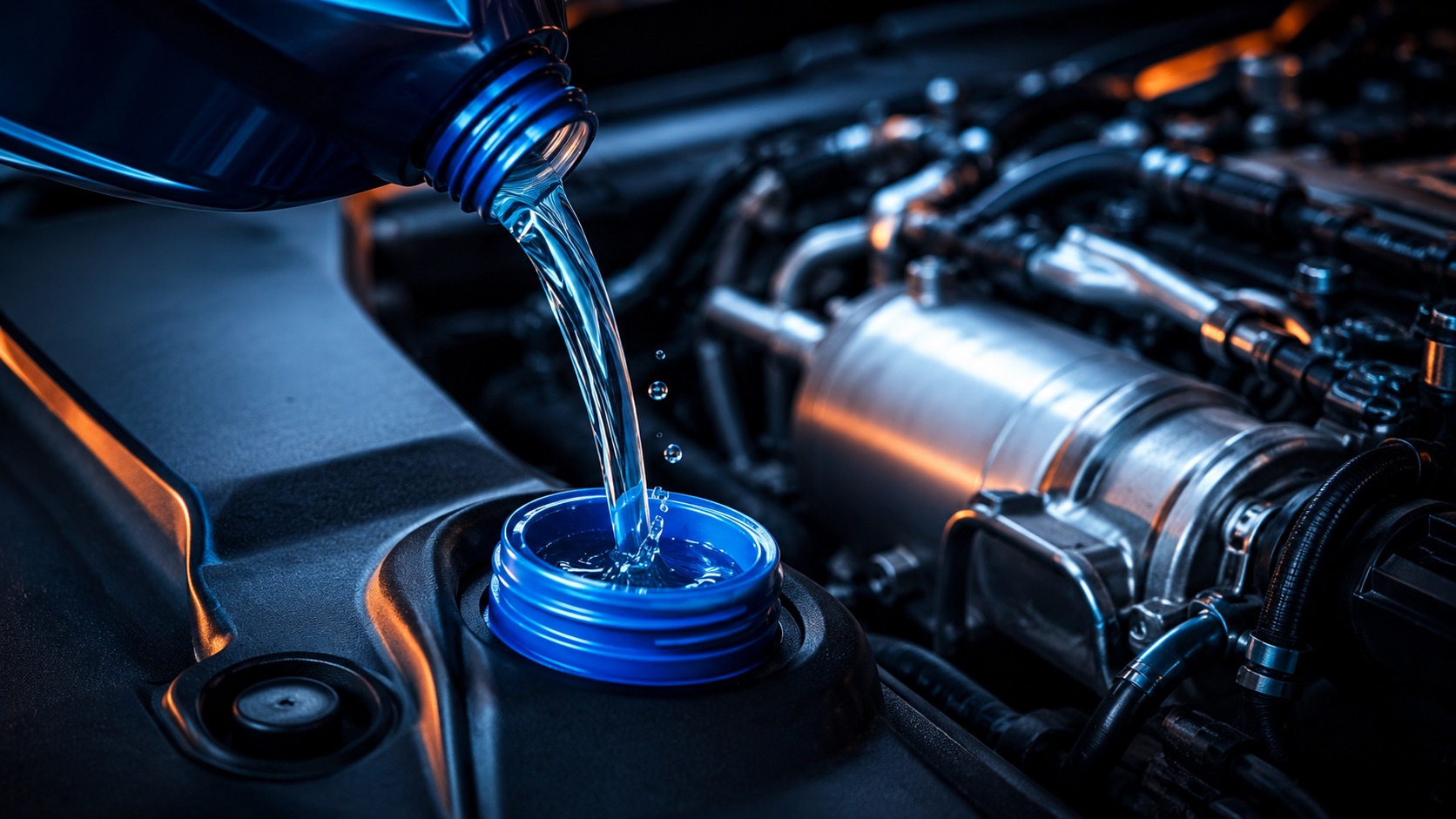
Let’s clear up a common mix-up first: AdBlue is not a fuel additive. It isn’t poured into your diesel tank. It lives in a completely separate reservoir and is a clear solution of 32.5% urea and 67.5% deionised water. Its job begins in the exhaust, not the combustion chamber.
The system’s name is SCR — Selective Catalytic Reduction. The principle is straightforward: when a diesel engine burns fuel at high temperature it produces large amounts of nitrogen oxides (NOx), a group of gases harmful to health and the environment. The SCR system injects tiny, precisely metered doses of AdBlue into the exhaust flow. In the heat, the urea first converts to ammonia, which then reacts with NOx inside the catalyst and leaves behind harmless nitrogen (N₂) and water vapour. In effect, the system reduces a toxic gas back into two of the main ingredients of the air we breathe.
This technology became mandatory on heavy vehicles with Euro 4, and with Euro 6 it spread to the vast majority of passenger cars and light commercials. Today, from a Ford Transit to a Mercedes Actros, from a Renault Master to a VW Amarok, nearly every modern diesel carries an SCR system. On paper it’s an elegant way to clear emissions limits — right up until one of the components fails.
How SCR Works: The Components and Their Jobs
SCR isn’t a single part; it’s a chain of linked components, and the weakest link can lock the whole system. Here are the main players and what each one does:
| Component | Role |
|---|---|
| AdBlue tank and level/quality sensor | Stores the fluid; reports remaining volume and fluid quality to the ECU |
| Dosing (supply) pump | Delivers AdBlue from the tank to the injector under pressure |
| Dosing injector | Sprays a precisely metered amount into the exhaust flow |
| SCR catalyst | The chamber where the chemical reduction reaction takes place |
| NOx sensors (upstream/downstream) | Measure nitrogen-oxide levels before and after the catalyst |
| Temperature sensors | Confirm the system is hot enough for the reaction to run |
| Control module (ACM / DCU) | The electronic brain that manages dosing and fault decisions |
The main engine brain (ECU) talks to these units constantly. It sets the dose based on the NOx readings; if the downstream sensor still sees high NOx, it increases the dose. This feedback loop is extremely sensitive — and that very sensitivity is what leaves the system so exposed to faults. The moment one sensor sends back a nonsense value, the brain reads it as “emissions limit exceeded.”
In practice: most SCR faults trace back not to the catalyst itself but to the small, expensive electronics feeding it — NOx sensors above all. Before a workshop declares “the catalyst is finished,” ask them to verify the sensor readings first. It sometimes saves you an unnecessary catalyst bill.
Which Faults Does the AdBlue/SCR System Throw?
There’s little this system hasn’t put owners through. Because it runs a urea solution in a permanently hot, corrosive environment, the components tire, clog, or start misreading over time. Here are the most common failures with their tell-tale symptoms:
| Fault | Typical symptom |
|---|---|
| NOx sensor fault (upstream/downstream) | Engine warning light, repeating AdBlue warning, system that trips to alarm almost immediately |
| Dosing pump failure | Low-pressure fault, no dosing, the start of a countdown warning |
| Dosing injector blockage | Urea crystallisation, dosing leak/shortfall, logged fault code |
| Quality / level sensor fault | ”No AdBlue” or “low quality” warning even with a full tank |
| Crystallisation (poor fluid / cold) | White crystal build-up on injector and lines, dosing breakdown |
| SCR / ACM (control module) fault | The whole dosing process stops, loss of communication with the system |
| Freezing at low temperature | Temporary winter fault, no dosing until the fluid thaws |
These faults share a common fate: they rarely come alone and they tend to recur. Replace one NOx sensor and it’s no surprise when, a few months later, the second sensor or the pump kicks off the same script. When the system detects a fault the vehicle first warns you, then starts the “won’t run after X km” countdown, then limits your speed, and finally refuses to run at all. If you want to dig into that staged inducement and the limp-mode sequence in detail, take a look at our guide to AdBlue fault symptoms and limp mode.
Watch out — a winter-specific note: AdBlue freezes at around -11°C. Tanks and lines are heated, but on a vehicle parked outside in the cold for a long time the fluid can freeze; the system then can’t dose until it thaws and throws a fault. Poor-quality or diluted AdBlue both crystallises more readily and fools the quality sensor into logging needless codes. Cheap fluid usually comes back to bite you in the form of an expensive injector clean.
Why the Fix Depends on the Engine ECU, Not the Badge
The solution to a given fault depends far less on the vehicle’s make than on the type of engine ECU underneath it. In the emulator world the logic is “which ECU,” not “which brand” — because the same manufacturer can fit different brains across models, while different manufacturers can share the same brain. Choosing the right solution comes down to identifying the electronic brain at the end of the socket, not the model name on the tailgate.
A few of the pairings you’ll meet most often:
- Renault / Nissan / Opel: commonly the MD1CS016 or SID321 units
- Ford: frequently the SID212
- PSA (Peugeot / Citroën) and some Toyota: MD1CS003
- Iveco: MD1CS069 or MD1CE101
- Mercedes: the MRD1 family across many models
That’s why “is there an AdBlue emulator for a Renault?” has no one-word answer. One Renault model may carry a SID321, another an MD1CS016, and the correct device is chosen accordingly. When you reach us with the VIN or the exact model and year, we can pin down the ECU type and specify a precisely matched solution — which is far safer than guessing from the badge.
What Does a Genuine Repair Actually Cost?
Here’s the part that stings. SCR components are both expensive and so interdependent that you can rarely say “I changed one part, I’m sorted.” To give you a rough sense of scale:
- NOx sensor: a costly item on its own — and most vehicles carry two, one upstream and one downstream.
- Dosing pump / injector: among the most frequently renewed parts thanks to crystallisation; with labour, a serious sum.
- SCR catalyst: the priciest component in the system; on heavy vehicles the figure alone can exceed a small repair budget for the whole vehicle.
- ACM / DCU control module: rare, but when it fails both the part and the coding/labour run high.
Stack those line items up and a single SCR repair reaching into four figures is the rule, not the exception. More maddening still: the new part may well fail again within a few years under the same operating conditions. And on the long-haul and heavy-vehicle side there’s an extra cost layered on top — being stranded: recovery, the workshop queue, a wasted trip, a late delivery. It’s precisely this recurring-cost loop that pushes most owners to look for a permanent answer.
The AdBlue Emulator: A Plug-and-Play Permanent Fix
An AdBlue removal emulator is a small piece of hardware that electronically simulates the SCR system. It plugs into the vehicle’s AdBlue/SCR control-module socket and feeds the engine brain the correct signals — as if everything were running perfectly. Because the brain sees healthy values, it neither logs fault codes nor triggers the inducement mechanism. The upshot:
- No AdBlue/SCR warning light,
- No “won’t run after X km” countdown and no speed limit,
- No limp mode — full power and torque are retained,
- No risk of being stranded by a failed sensor or pump,
- AdBlue fluid consumption ends completely.
An important distinction is worth stressing here: this is not a remap (software) operation. We don’t edit the code inside the ECU; what we supply is a plug-and-play device that clips into the original socket. It needs no cutting or soldering, does no harm to the vehicle’s electronics, and can be unplugged when required to return the system to standard. If you’d like to go deeper on the difference between a software solution and a hardware emulator, I’d recommend reading our emulator vs. software/remap comparison.
Because picking the right device depends entirely on the ECU type, the most practical route is simply to reach us with your chassis number or model and year. To find the AdBlue removal emulator suited to your vehicle, browse our full product range, and drop us a message on WhatsApp for a compatibility check wherever you’re unsure.
Legal note: modifying or removing emissions equipment is subject to legal restrictions on road use and roadworthiness inspection in many countries. Our products are supplied for off-road, export, motorsport, and testing purposes only, and compliance with local legislation is the sole responsibility of the user.
Frequently Asked Questions
What exactly is AdBlue — is it a fuel additive?
No. AdBlue is not something you pour into the fuel tank. It's a separate solution of 32.5% urea and 67.5% deionised water, stored in its own tank and sprayed into the exhaust. It works on the exhaust gas, not inside the engine, to break down NOx.
Will the vehicle stop running once AdBlue runs out?
If the tank empties completely and the system has no fluid, most vehicles first show a countdown warning, then impose a speed limit, and eventually refuse to restart. This 'inducement' is a legally mandated behaviour, not a glitch.
Does AdBlue freeze in winter, and does that affect the vehicle?
AdBlue freezes at roughly -11°C. Tanks and lines are heated, but a vehicle left in the cold for a long spell can throw a temporary fault until the fluid thaws and dosing resumes. Poor-quality AdBlue makes this far more likely.
Which AdBlue fault is the most expensive?
Usually NOx sensor and SCR catalyst replacement; on heavy vehicles the dosing pump and the ACM/DCU control module are costly too. Even a single sensor swap runs into serious money on most vehicles — and the fault often comes back.
Does an AdBlue emulator reprogram the engine ECU?
No. An emulator is not a software remap. It's a plug-and-play device that clips into the original socket. It never touches the ECU firmware, needs no cutting or soldering, and can be unplugged to return the system to standard.
Looking for the right emulator for your vehicle?
Send us your make and chassis details and our experts will find the right solution in seconds.