
AdBlue Crystallisation & Freezing: Why a Reset Won't Fix It

A January morning, and there’s a Transit up on the ramp. Overnight the town dropped to -15°C. The owner explains: “There was nothing wrong last night. I started it this morning, the dash lit up amber, and the speed locked at 60.” You bring it in, plug in the diagnostic tool, and the picture on screen is a familiar one: P20BA, P205B, the odd P20E8. You open the tank cap and the AdBlue inside has turned to jelly, frozen solid.
This isn’t really a fault; it’s a weather event. But the vehicle doesn’t know that. The SCR system sees that it can’t do its job, NOx reduction drops, and the emission logic steps in and pulls the engine into power loss. The maddening part is that once the fluid thaws and the air warms up the problem vanishes for a while, then comes straight back at the first cold snap or after a handful of short trips. In this article we walk through, step by step, why the two distinct winter problems, AdBlue crystallisation and AdBlue freezing, are never cleared by a simple reset.
What Is AdBlue, Really? The Chemistry Behind the Freezing Point
Let’s start with the chemistry, because that’s where the problem lives. AdBlue isn’t some magic fluid; under the ISO 22241 standard it’s a solution of 32.5% urea and 67.5% deionised water. In the SCR catalyst it breaks down under heat into ammonia, and that ammonia turns the harmful nitrogen oxides (NOx) in the exhaust into harmless nitrogen and water. When it works properly it cuts NOx emissions dramatically. The technology is clean and the chemistry is well settled.
But this blend has a weak spot: it’s mostly water. And water freezes. The freezing point of AdBlue is around -11.5°C (some sources quote -11°C). Across much of the UK, and further afield, winter nights drop well below that. Manufacturers know this; they build electric heater circuits into the tank and the feed lines. While the vehicle is running, those heaters keep the fluid flowing. The trouble begins when it’s parked in the cold for a long stretch with the engine off: the heater gets no power and the fluid turns to stone.
In practice: Frozen AdBlue does no mechanical harm to its tank; the solution expands as it freezes, but the tanks are designed for that. The real issue is that frozen fluid can’t be pumped and the sensors reach the verdict that “the system isn’t working.”
Crystallisation: The Urea Deposit at the Injector Tip
Freezing is seasonal and temporary. Crystallisation is far more insidious, because it doesn’t disappear when the air warms up. AdBlue crystallisation happens when the water in the urea solution evaporates and leaves solid urea crystals behind. This white, hard, chalky deposit builds up mostly at the injector tip and around the dosing nozzle, exactly where the fluid is sprayed into the exhaust and the heat is highest.
Why does it build up there? Because the injector tip sits very close to a hot surface. As the fluid leaves as fine droplets it rapidly loses its share of water, and the urea that’s left behind cools and solidifies. Four main conditions trigger crystallisation, and they usually work together:
- Frequent heat cycles: the engine constantly heating and cooling drives repeated evaporation around the nozzle.
- Short trips: the SCR catalyst never reaches operating temperature, so the system leaves partly burnt deposits behind.
- A loose or leaking tank cap: air ingress speeds up evaporation and throws off the fluid’s concentration.
- Poor-quality or diluted fluid: an off-spec urea ratio raises the tendency to crystallise.
Caution: If it’s a delivery van doing a few miles a day around town, the SCR barely warms up at all. These are the vehicles most exposed to crystallisation; they can suffer this fault even in summer. The problem isn’t unique to winter, cold just speeds it up.
Code Table: Which DTC Tells You What?
The diagnostic screen can get crowded, and telling which code points to freezing and which to crystallisation saves time. The table below gathers the most common codes alongside their likely root causes. If you want to see all the emission fault codes in one place, take a look at the diesel emission fault code guide as well.
| DTC Code | Meaning | Likely Root Cause |
|---|---|---|
| P20E8 | SCR reagent pressure too low | Injector/line blockage, crystal build-up |
| P204F | SCR system performance | Insufficient dosing, crystallisation |
| P207F | SCR reagent quality/performance | Poor-quality fluid, deposits |
| P20BD | Reductant heater A circuit (low-voltage variant) | Heater fault, freezing condition |
| P20BA | Reductant heater A circuit (open-circuit variant) | Heater supply issue |
| P205B | Reagent tank temperature sensor | Freezing, sensor reading error |
These codes are stored in different ECUs depending on the vehicle model. On Mercedes vehicles like the Sprinter the controller is usually from the MRD1 family; on the Ducato and Iveco side it’s MD1CS069, and on the Transit and other Fords you’ll meet SID212. On the Renault Master it’s MD1CS016 or SID321, and on the Citroën and Peugeot Berlingo side you’ll see MD1CS003. On heavy vehicles like the Actros the EAS4 dosing module often comes into play too. Even when the code is identical the physics of the fault doesn’t change: either the fluid has frozen, or the nozzle is blocked with crystal.
Why Doesn’t a Reset Work? Software Versus Physics
The reset is the most misunderstood part. Plenty of drivers and inexperienced mechanics clear the fault codes with a diagnostic tool the moment the warning appears; the light goes out and the vehicle behaves normally. “There, sorted,” they say. A week, sometimes a day later, the same light comes back on. Why?
Because what we call a reset is simply wiping the record from memory. You clear a line in the ECU’s fault store, and that’s it. But the crystal is still sitting there at the injector tip; solid, real, something you can touch. On the next measurement the sensor sees the pressure is low again, works out the dosing is falling short, and writes the code back. Software can’t see a physical problem; it only reports its consequence.
In practice: The only real way to clear the crystal is mechanical intervention; removing the injector and cleaning it with a special solvent, or replacing it. The way to deal with freezing is heat; bringing the vehicle into a warm space and waiting for the fluid to thaw. No diagnostic tool can do either.
Here’s the important bit: even if the cleaning or the thaw fixes the problem once, it comes back as long as the conditions persist. If the same short trips, the same cold parking spot, the same leaking cap continue, the crystal builds up again and the fluid freezes again. It’s like bailing water out without plugging the hole in the bucket. If you want to dig deeper into the logic behind the symptoms, the article on AdBlue fault symptoms and limp mode explains this loop in detail.
The Winter AdBlue Maintenance Kit
You can’t reduce the risk of crystallisation and freezing to zero, but delaying it is in your hands. The comparison below sets the two problems side by side:
| Criterion | Freezing | Crystallisation |
|---|---|---|
| Trigger | Temperature ≈ below -11.5°C | Evaporation + heat cycling |
| When | Winter-specific, temporary | Year-round, permanent |
| Location | Tank and lines | Injector tip, nozzle |
| Does a reset fix it? | No | No |
| Real fix | Warming / heater repair | Mechanical cleaning / replacement |
| Does it recur? | Every cold spell | As long as conditions persist |
What to do before winter is simple: always tighten the tank cap fully and check its seal. Use only ISO 22241-compliant, standard AdBlue; steer clear of cheap diluted fluid. Where you can, park the vehicle indoors or somewhere sheltered from the wind. And most important, if you drive short distances, take the vehicle for one long run a week so the SCR fully warms up. That single habit sharply lowers the risk of crystallisation.
Breaking the Recurring Loop: Where the Emulator Fits
Say you’ve had the injector cleaned, brought the fluid up to spec, and replaced the cap. If the same short-trip profile and the same cold climate carry on, the fault will return sooner or later. At this point many fleet owners and commercial-vehicle operators want to end the power-loss and countdown-warning loop the system keeps triggering, once and for all.
A clear distinction is needed here. An emulator is not a remap or a software modification. It doesn’t touch the ECU’s software and it needs no cutting or soldering. It’s a plug-and-play device that fits into the original socket; by conditioning the signals the SCR sensors see, it stops the vehicle from going into limp mode and stops the countdown warnings. It fits in about ten minutes and can be unplugged whenever you like to return the vehicle to standard. It doesn’t physically clear the crystal, but it breaks the recurring fault and power-loss loop that the crystal or the freeze creates; the vehicle isn’t left stranded.
If you’re curious about the general logic of the SCR system and why it gets bypassed, the article on what AdBlue SCR is and why it’s disabled is a good starting point.
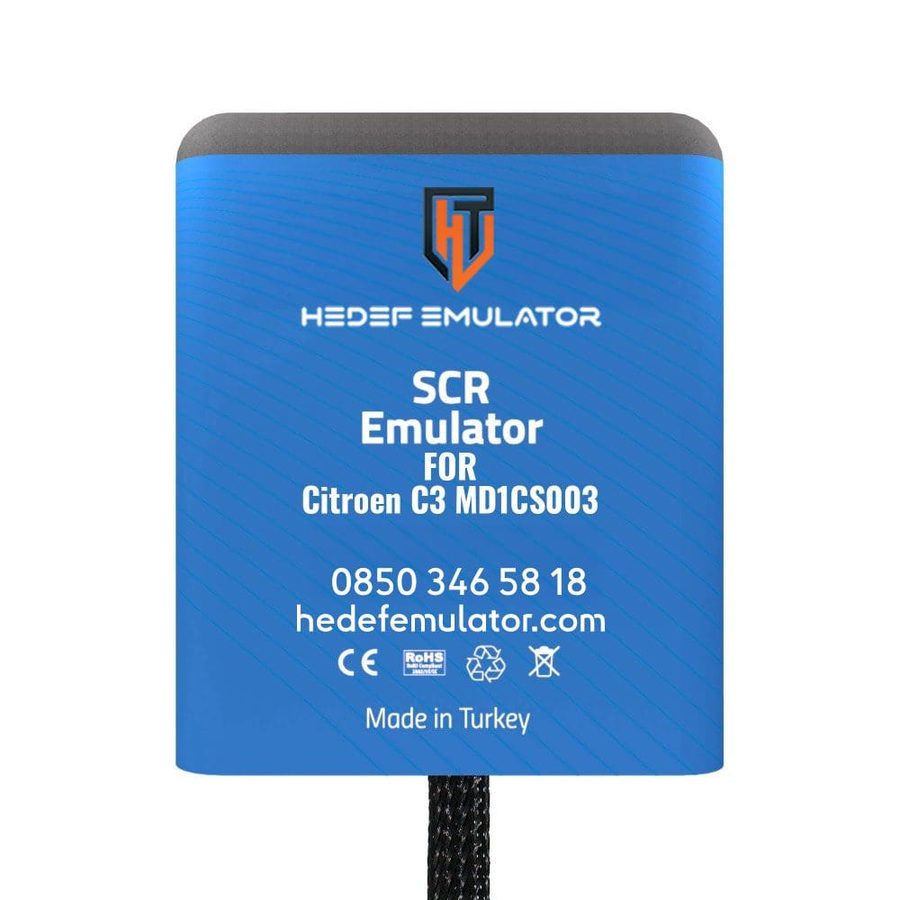 RECOMMENDED DEVICECitroën C3 MD1CS003 AdBlue SCR Removal EmulatorView product →
A Few Notes for Making the Right Call
No two vehicles or usage profiles are the same. A driver who does long runs, changes the fluid regularly, and parks in a garage might go years without serious trouble. But for a Transit or Master doing city deliveries, stopping and starting dozens of times a day and spending the night in an open car park, crystallisation and freezing are an almost unavoidable maintenance item. Replacing injectors over and over on these vehicles means both cost and downtime.
When you make your decision, ask: did this happen once, or is it a seasonal loop? If it happened once, mechanical cleaning and good maintenance will most likely be enough. If you’ve entered the loop and can’t change the root conditions, a permanent solution makes more sense. Whichever route you take, at Hedef Emulator we help you find the right hardware for your vehicle across 12+ years of experience, 428+ products and 94 brands; with a 2-year warranty, free shipping and 14-day returns. If you get stuck, our 24/7 WhatsApp support line is open: 0507 687 18 40.
Legal notice: Modifying or disabling emission hardware is subject to legal restrictions on road use and inspection in many countries. Our products are supplied for off-road use, export, racing and testing purposes; legal responsibility rests with the user.
Frequently Asked Questions
At what temperature does AdBlue freeze?
AdBlue freezes at roughly -11.5°C (some sources quote -11°C). That is the freezing point of its 32.5% urea / 67.5% deionised water blend. The tank and lines are kept fluid by a heater circuit while the vehicle runs, but if it is parked in the cold for a long stretch with the engine off, freezing sets in.
Can an AdBlue crystal be cleared with a software reset?
No. The crystal is a physical urea deposit built up at the injector tip. A reset only wipes the stored fault code from memory; it does nothing to the solid deposit. The injector and line have to be cleaned mechanically or replaced, and if the conditions persist the crystal simply forms again.
Why does AdBlue crystallise?
The main culprits are frequent heat cycles, short trips where the SCR never fully warms up, a loose or leaking tank cap, and poor-quality or diluted fluid. Under these conditions the water evaporates and the urea is left behind as a white crystal at the injector tip.
Which fault codes does crystallisation trigger?
The most common are P20E8 (SCR pressure too low), P204F and P207F. On the freezing side you may also see P20BD/P20BA for the heater circuit and P205B for the tank temperature sensor.
Does an emulator solve crystallisation and freezing?
An emulator does not physically clear the crystal, but it ends the recurring fault and limp-mode loop that the SCR system keeps triggering. It is a plug-and-play device that fits into the original socket; the vehicle keeps running without power loss or countdown warnings.
Recommended Products
Looking for the right emulator for your vehicle?
Send us your make and chassis details and our experts will find the right solution in seconds.