
Diesel Emission Fault Codes Explained: AdBlue, NOx, DPF, EGR
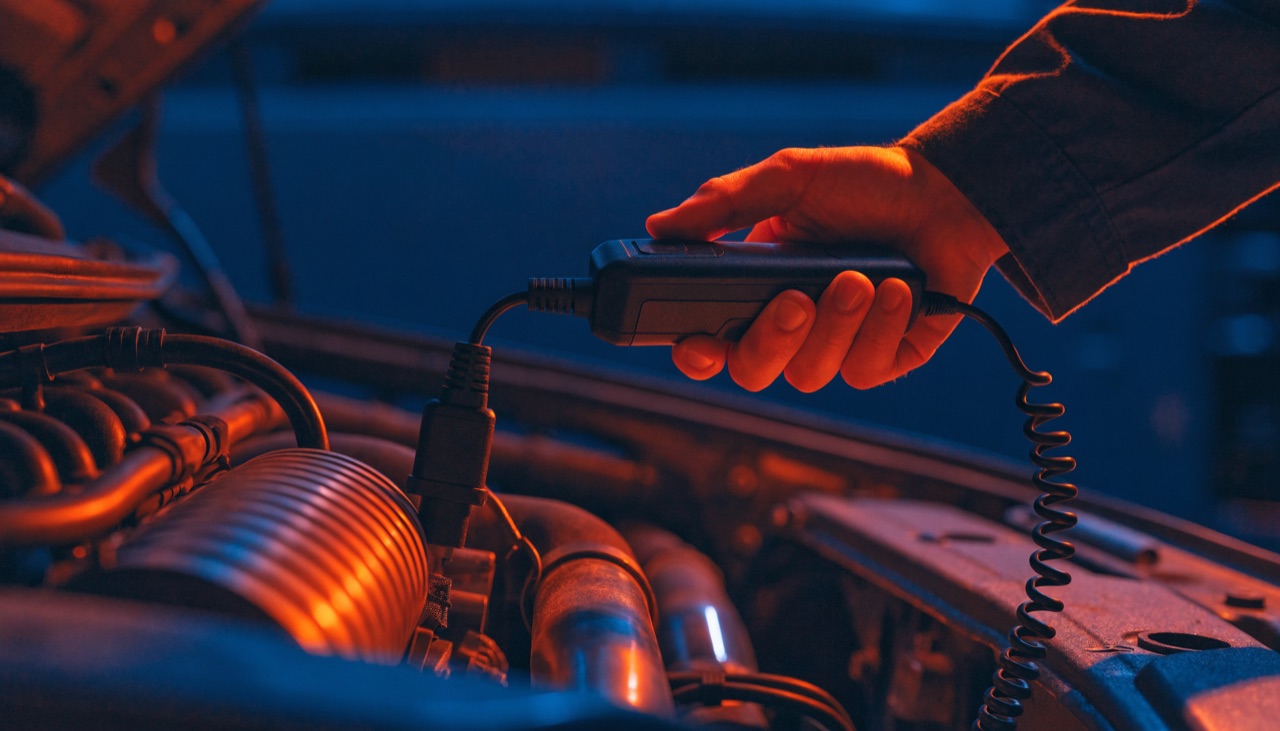
The ramp is easing back down when the mechanic turns his diagnostic tablet towards you. One line glows red on the screen: P204F. Next to it, a P20E8. Somewhere it reads “reductant system”, but that means little to you. Between the amber lamp that has been on the dash for a few days and the “engine will not start in 800 km” warning, one question is spinning in your head: what exactly does this code mean, and how much is it going to cost me?
You have a DTC code in hand and you want to know what sits behind it. Below we open up the four main branches of diesel emission systems (AdBlue/SCR, NOx, DPF and EGR) one by one, laying out the most common codes in tables by meaning, typical symptom and likely cause. Through a mechanic’s eyes, with none of the fluff.
AdBlue / SCR System Fault Codes
The AdBlue side is the biggest headache on modern diesels. The system sprays a urea-based fluid (AdBlue) into the exhaust and, in the SCR catalyst, converts NOx into harmless nitrogen and water. Break any link in that chain and the ECU starts warning you with a countdown. On PSA/Stellantis group vehicles (Berlingo, Partner and Ducato-related platforms) the bulk of AdBlue faults trace back to low pressure, i.e. P20E8.
| Code | Meaning | Typical symptom | Likely cause |
|---|---|---|---|
| P20EE | SCR NOx catalyst efficiency below threshold (severity 3/3) | Engine warning lamp, countdown, speed restriction risk | Catalyst ageing, poor-quality AdBlue, long-term dosing error |
| P204F | Reductant (AdBlue) system performance insufficient | Warning message, dosing cut-off | Low pressure, weak pump, blocked injector |
| P20E8 | Reductant pressure too low | Frequently recurring AdBlue warning | Pump failure, line leak, blocked filter |
| P207F | Reductant quality/performance insufficient | Quality warning, countdown | Counterfeit/degraded AdBlue, crystallisation |
| P203F | Reductant (AdBlue) level too low | Early/false ‘AdBlue empty’ warning | Genuinely low level, tank level sensor fault, poor wiring contact |
| P20BD / P20BA | Reductant heater A circuit (low/high/open-circuit variants) | No operation when cold, fault after freezing | Heater resistance fault, supply/circuit issue, low temperature |
| P205B | Reductant temperature sensor fault | Temperature reading error | Sensor failure, corroded connector |
In practice: P20E8 and P204F usually come together. When pressure drops, system performance drops with it, and the ECU logs both at once. Clearing P204F before you solve the pressure problem is a waste of time.
If you want a closer look at how the AdBlue warning turns into a countdown and slips into limp mode, take a look at the AdBlue fault symptoms and limp mode article.
NOx Sensor Fault Codes
NOx sensors report the amount of nitrogen oxide in the exhaust to the ECU. There are usually two: one at the catalyst inlet (upstream) and one at the outlet (downstream). Because these sensors work in a punishing environment under high heat and vibration, they age and are one of the most frequent sources of fault codes.
| Code | Meaning | Typical symptom | Likely cause |
|---|---|---|---|
| P2201 | NOx sensor circuit range/performance (upstream/inlet) | Engine warning lamp, rising AdBlue consumption | Sensor ageing, weakened heater, contamination |
| P2200 | NOx sensor circuit fault | Persistent fault, sensor not reading | Broken circuit, connector fault, dead sensor |
| P229F | NOx sensor heater control circuit (downstream/outlet) | Delayed reading on cold running | Heater resistance fault, supply issue |
P2201 is the most common NOx code on the list. If you are curious how a NOx sensor works, what its failure symptoms are and why it fails so often, the What is a NOx sensor and how to spot a fault article covers the topic from start to finish.
Caution: On many makes the genuine NOx sensor is a costly OEM part. A replacement can call for both sensors at once, and with labour on top the bill runs into a hefty sum. That is why many fleet owners turn to an emulator as the lasting fix.
DPF (Particulate Filter) Fault Codes
The DPF is the filter that traps soot particles in the exhaust. Over time it fills up and is cleaned by a burn-off cycle called “regeneration”. In short-distance city driving this cycle never fully completes, the filter clogs, and the differential pressure climbs. That is exactly where the codes below come into play.
| Code | Meaning | Typical symptom | Likely cause |
|---|---|---|---|
| P2002 | DPF efficiency below threshold | Engine warning lamp, loss of power | Filter ageing, crack, sensor fault |
| P244B | DPF differential pressure too high | Regeneration warning, limp mode | Excessive soot build-up, blockage |
| P2463 | DPF soot accumulation (also common on Mercedes) | Frequent regeneration requests, drop in performance | Incomplete regeneration, short-distance use |
In practice, when you see P244B the first step is a forced regeneration. If the filter stays full or there is a crack, the situation changes; here clearing the code will not do, and physical work is needed.
EGR System Fault Codes
The EGR valve routes part of the exhaust gas back into the combustion chamber to reduce NOx formation. This gas carries soot, and over time the valve clogs with carbon. Among the EGR codes, one is so common it overshadows the rest.
| Code | Meaning | Typical symptom | Likely cause |
|---|---|---|---|
| P0401 | EGR flow insufficient | Rough idle, loss of power, smoke | Soot blockage, valve sticking (closed) |
| P0402 | EGR flow excessive | Shaky idle, black smoke | Valve stuck in open position |
P0401 is the king of EGR faults; it shows up many times more often than P0402 because soot build-up eventually pushes the valve towards the closed side on almost every diesel. Both codes are, at heart, two faces of the same disease: carbon.
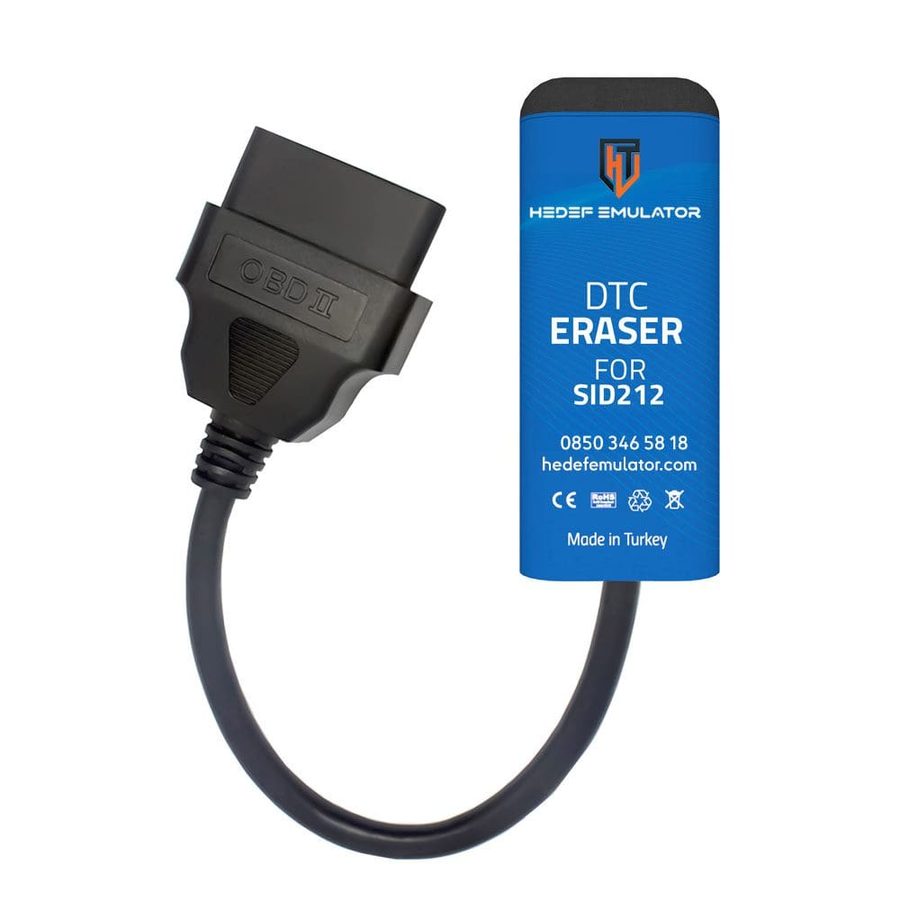 RECOMMENDED DEVICESID212 ECU Euro 6 DTC Fault Code EraserView product →
Manufacturer-Specific Codes: Everyone’s Own Language
Alongside the generic OBD codes, every make also keeps its own internal code set. The same fault can look different depending on the scanner.
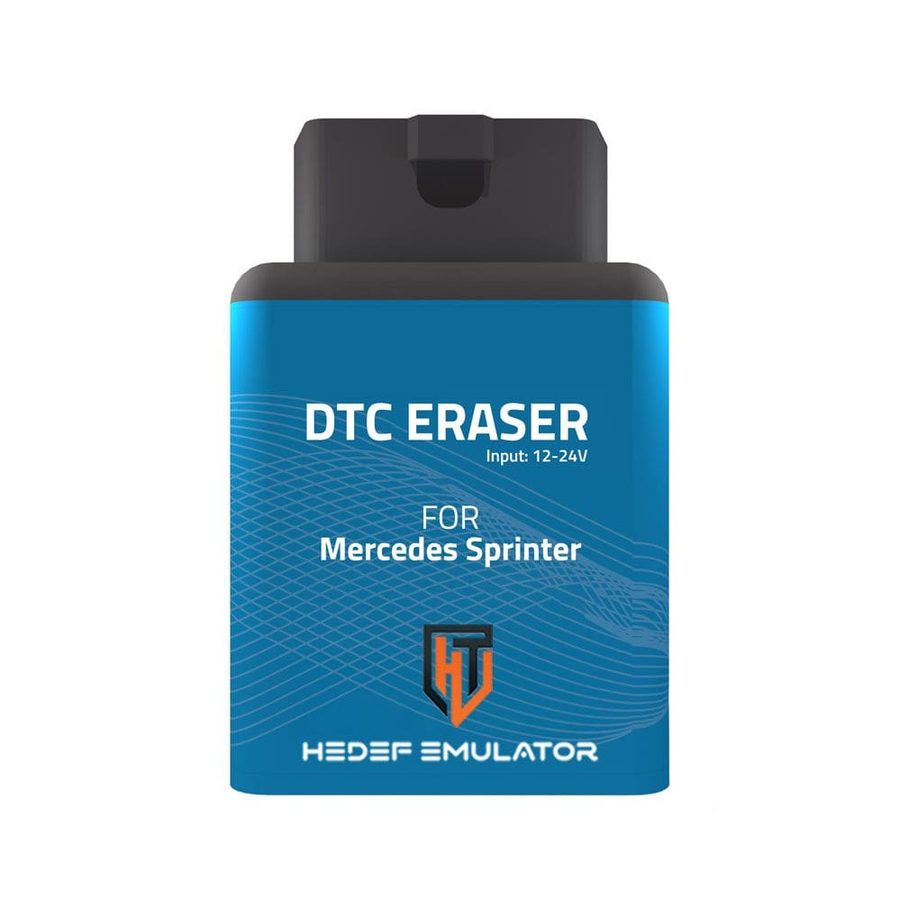
Mercedes Sprinter (OM651 / OM654): On these engines, Mercedes-specific codes such as P13DF, P203B, P20FA and P208A appear often on the AdBlue and SCR side. They are usually tied to reductant dosing, pressure and catalyst efficiency. On Sprinters the ECU side is largely the Bosch MRD1 family; that ECU type is decisive when choosing the right emulator.
Renault Master / Trafic: Renault’s DF050 code does not point to a single part; it is a collective fault code covering the injectors, pump and NOx sensors all at once. So when you see DF050, saying “that specific part is broken” on its own is misleading; you need to check several points in the system at the same time. These vehicles often use SID321 or similar ECUs.
Ford Transit: On Transits, most AdBlue faults are pump-related. When the pump weakens, pressure drops, the ECU cannot dose, and performance codes cascade open one after another. Some Transits carry SID212-based ECUs.
Caution: The same code calls for a different fix across different engines and ECUs (such as MD1CS003, MD1CS069, SID212, MRD1, DENSO D5E1C). When choosing an emulator, correctly identifying the vehicle’s ECU type is essential; a wrong match will not work. That is why getting adviser support with your chassis and ECU details is the safest route.
Why Won’t These Codes Just Clear?
We have added a “will not clear by wiping” note after almost every code. The reason is simple. Emission codes are not an ordinary warning light; the ECU writes them to permanent fault memory and continuously monitors the data coming from the relevant sensor. The moment you erase them with a tool, the ECU keeps reading the same low pressure, the same aged sensor, the same clogged filter. The code returns within a few miles; on most vehicles the countdown and speed restriction start over too.
So there are two real roads ahead of you. The first is a physical repair: replacing the faulty sensor, pump, filter or valve. This is sometimes the right choice, but with a genuine part, labour and the chance of the fault recurring, it means a serious outlay. The second is the emulator.
Let us draw a clear line here, because it gets confused a lot. An emulator is not a remap or software. It is a plug-and-play device that fits into the original socket. It never touches the ECU software, needs no cutting or soldering, and fits in about 10 minutes. The system sees the correct signal it expects from the sensor; the code does not appear, the countdown does not start, and the vehicle runs normally. Best of all, it is reversible: when needed it can be unplugged to return the vehicle to standard. When it comes to an inspection, a sale or any other need, that flexibility is valuable.
For a detailed answer to the question of which fault calls for a replacement and which for an emulator, take a look at the NOx sensor: replace or emulate comparison.
Choosing the Right Emulator
The code in your hand tells you the system, but the fix needs the vehicle’s make, model and ECU type. The same P2201 code calls for different hardware on a Transit than on a Master. At Hedef Emulator we stock more than 428 products for 94 makes; with over 12 years of experience, we know which chassis comes with which ECU.
If you are unsure, just send your chassis number and the code you see to our 24/7 WhatsApp support line (0507 687 18 40) and we will pin down the right model together. Our products come with a 2-year warranty, free shipping and your 14-day return right intact.
Legal notice: Modifying or disabling emission hardware is subject to legal restrictions on road use and inspection in many countries. Our products are supplied for off-road use, export, racing and testing purposes; legal responsibility rests with the user.
Frequently Asked Questions
What does the P204F fault code mean?
P204F reports that reductant (AdBlue) system performance is outside the expected range. In plain terms, the ECU cannot dose AdBlue correctly, or the values it reads back are inconsistent. It usually shows up alongside low pressure (P20E8), a weak pump or a blocked injector. The code is written to memory and will not clear for good by wiping alone until the physical fault is fixed.
Why does P2201 appear, is the NOx sensor faulty?
P2201 is a range/performance fault on the upstream NOx sensor and is the most common of all the NOx codes. The sensor's heater element ages, the ceramic measuring cell gets contaminated, or there is a poor connection in the wiring. Replacing the sensor is one option; for a lasting and more economical fix, a NOx emulator is also used.
Can AdBlue fault codes be cleared by wiping them?
No. Emission codes such as P20EE, P204F and P20E8 are stored in the fault memory. Even if you erase them with a tool, the ECU keeps reading the same sensor data and the code returns within a few miles; on most vehicles the countdown and speed restriction kick back in too. The permanent answer is either a physical repair or emulator hardware.
What is the difference between the P0401 and P0402 EGR codes?
P0401 means 'EGR flow insufficient' and, due to soot blockage, is by far the most common EGR code, many times more frequent than P0402. P0402 is the opposite, 'EGR flow excessive', meaning the valve is stuck in the open position. Both are tied to soot and carbon build-up.
Does an emulator damage the ECU software?
No. An emulator is a plug-and-play device that fits into the original socket; it never touches the ECU software and needs no cutting or soldering. It fits in about 10 minutes and can be removed to return the vehicle to standard when needed. That is exactly what sets it apart from a remap or software intervention.
Recommended Products

Looking for the right emulator for your vehicle?
Send us your make and chassis details and our experts will find the right solution in seconds.