
How to Reset an AdBlue Warning: 4 Methods and Why They Fail

When the fitter handed me the ticket for the Transit that had just rolled into the workshop, there was a single line on it: “AdBlue light on, topped it up yesterday, didn’t clear.” I couldn’t count how many times a month I hear that sentence. The owner had done the sensible thing; filled the tank, waited for the warning to disappear. It didn’t. Because his problem had nothing to do with the fluid level in the tank.
That is exactly the point. Most people searching for “how to reset AdBlue” are actually squeezing two completely different problems into one question. In one, a reset genuinely works and gets you back on the road in five minutes. In the other, no amount of ignition cycling or battery disconnecting changes a thing; because what you are facing is not a warning you can clear with software, but a physical fault. In this article I’ll walk through all four methods one by one, but more importantly I’ll spell out exactly when each one won’t work.
First, Draw the Line: Level Warning or System Fault?
An AdBlue warning comes from two very different sources, and the two are nothing alike. The first is the harmless one: the fluid in the tank has run low and the system tells you to top up. The second signals that something in the SCR system has gone wrong; the NOx sensor, the level or quality sensor, the dosing pump or the injector.
The most practical way to tell them apart is to watch how the car behaves. A simple level warning usually gives you plenty of room; on most cars and light commercials you get roughly 1,500 to 3,000 km of range before the tank has to be filled, and the gauge drops gradually. A system fault is far more impatient. With a sensor or pump failure the car corners you much faster, sometimes reaching a no-start lockout within a few hundred kilometres. The range melts away quickly and topping up does not stop it.
In practice: If you have filled the tank, cycled the ignition a few times or taken a short drive and the warning is still stubbornly on, you are almost certainly looking at a system fault. A level warning goes quiet the moment it sees fluid; a fault code doesn’t look, it feels, and it comes back.
Method 1: Ignition On/Off (Ignition Cycle)
This is the most harmless and most reliable method, but only in the right scenario. If your tank is full and the warning really is level-related, a few ignition cycles are usually enough for the system to re-read the fluid.
It’s simple to do. Without starting the engine, turn the ignition on, let the dash lights come up and wait 20 to 30 seconds for the system to settle, then switch it off. Repeat that a few times in a row. On some cars the warning clears within this cycle; on others the real reading only happens once the engine runs and the level sensor confirms the fluid.
Caution: An ignition cycle does not erase a fault, it only tells the system to “look again.” If there is a code stored in the background, this method does nothing; you just waste your time.
Method 2: Fill the Tank Completely + a Short Drive
This is the actual fix for a level warning, no magic involved. Most systems do not read the AdBlue level in real time; they update it at set intervals or after a certain amount of driving. That is why adding half a litre and asking “why didn’t it clear” is misleading.
The right approach is to fill the tank properly, ideally well above the stated minimum threshold. Then run a few ignition cycles and go for a short drive. When the system re-reads the level and the fluid is sufficient, the warning switches off on its own. On some cars this takes a few minutes, on others a few kilometres.
Use quality AdBlue that meets the standard. Cheap or watered-down fluid can trip the quality sensor and land you in a quality fault that is far more stubborn than a level problem. At that point you don’t need to top up, you need to clean out the system.
Method 3: Accelerator Pedal Sequence with Ignition On
On some models and trims, a specific press-and-release sequence on the accelerator pedal with the ignition on (engine off) triggers a service/warning menu or a re-read. This method varies by brand and ECU generation; it doesn’t work on every car and there is no universal “code.”
Let me be blunt about it: pedal sequences rarely do more than refresh a level warning. They do not erase a stored DTC. So if a sensor-related code has settled into an ECU like an MD1CS003 or SID321, no matter how hard you press that pedal, the code stays put.
Method 4: Disconnecting the Battery
This is the most widely circulated and most misunderstood method online. Disconnecting the negative battery terminal for a few minutes resets volatile memory; yes, some momentary warnings can disappear. But this is not a reset, it is an attempt to make the system forget.
Here’s the catch: a fault code written permanently to the ECU is not erased by disconnecting the battery. Crystallisation is physical, and the battery won’t melt it. If a sensor or pump is faulty, the moment power returns the system detects the same fault again and puts the warning right back. On top of that, you risk resetting other learned settings without realising it and losing your radio or comfort codes.
Caution: On a system that counts remaining engine starts, disconnecting the battery can make things worse. If the counter is near zero, one wrong move can drop you straight into a no-start lockout.
Why Do None of the Methods Sometimes Work?
All four methods above hit the same basic truth: a reset clears a warning tied to fluid level; it does not clear a physical fault or a stored fault code.
In three situations no DIY method will save you. The first is a stored DTC. Once the system has written a code like P204F or P20E8 to the ECU, that code only goes away when the fault is fixed and cleared with a diagnostic tool; the ignition, pedal or battery won’t even see it. The second is crystallisation. AdBlue can crystallise in the cold or over time and block the injector or the lines; that is a physical blockage, and software won’t open it. The third is a hardware fault. If the NOx sensor or the dosing pump has failed, the system can’t get a correct reading and keeps holding the warning.
I’ve gone into these differences in more depth in the article what a NOx sensor is and how to spot a fault; if you want to trace the warning all the way down to the sensor, you can carry on from there.
Remaining Starts: The Sneaky Counter on French Systems
While most cars corner you with kilometres, PSA-derived French systems (models like the Berlingo, for instance) count remaining engine starts instead of distance. The display tells you “1000 starts left,” then 999, 998, counting down.
Once that counter reaches zero, the car will not start again. And here is the bitter part: at that point even adding AdBlue on its own won’t free it up. You put the fluid in but the car still won’t crank, because the lock is tied to the reset counter, not the fluid level. In that case the system has to be restarted with a diagnostic tool. In other words, taking the countdown seriously while it is still in the thousands is far cheaper than taking it seriously at three.
If you see the words “remaining starts” on your dash, don’t put it off. Every start knocks one off the counter, and when the counter runs out the car ends up not on the road but on the back of a tow truck.
Decision Table: Will a Reset Work or Not?
The table below is basically the whole article in summary. Find your situation, see whether a reset will save you, then look at what it actually takes.
| Situation | Will a reset work? | What it actually needs |
|---|---|---|
| Simple level/fluid warning, tank topped up | Yes | Top up + a few ignition cycles / short drive; ~1,500-3,000 km of range returns |
| Stored DTC (P204F / P20E8) | No | Fix the fault + clear the code with a diagnostic tool, or disable the SCR with an emulator |
| AdBlue crystallisation / blockage | No | Physical cleaning / part replacement; software won’t open it |
| NOx sensor or level/quality sensor fault | No | Sensor replacement or preventing the signal at source with an emulator |
| Dosing pump / injector fault | No | Pump/injector repair or replacement; a reset just brings the warning back |
| Remaining starts hit zero (PSA) | No | Restart with a diagnostic tool; adding AdBlue alone is not enough |
Let’s use a second table to make clear when each method actually makes sense:
| Method | When it works | Its limit |
|---|---|---|
| Ignition on/off | Tank full, level warning only | Won’t erase a stored code |
| Fill tank + short drive | Genuinely low level | Useless on a sensor/pump fault |
| Accelerator pedal sequence | Level refresh on some models | Not universal; won’t clear a DTC |
| Disconnecting the battery | Momentary transient warnings | Won’t erase a physical fault or a permanent code; risky |
When the Warning Keeps Coming Back: The Permanent Fix
If a warning keeps stubbornly returning no matter how much you top up, reset or disconnect the battery, you need to read the message clearly: there is a physical fault underneath and a reset won’t close it. There are two real routes. Either you replace the failing part (sensor, pump, injector), which on heavy vehicles is genuinely a costly job; or you disable the SCR system from the outset so the fault is never logged in the first place.
The second route is where an emulator comes in. Let me clear up a misconception here: an emulator is not a remap or a software trick. It is a plug-and-play piece of hardware that fits the original socket. It doesn’t touch the ECU firmware, needs no cutting or soldering, takes a specialist around 10 minutes to fit, and can be unplugged to return the car to standard when needed. Because it continuously feeds the system an “all is well” signal, codes like P204F and P20E8 never settle in the first place; so you’re not fighting to clear the warning, the warning is never born.
I’ve broken down from start to finish why the SCR logic generates so many faults, and the background to deleting it, in the article what AdBlue / SCR is and why people delete it. Before you make your call, it’s worth a look too.
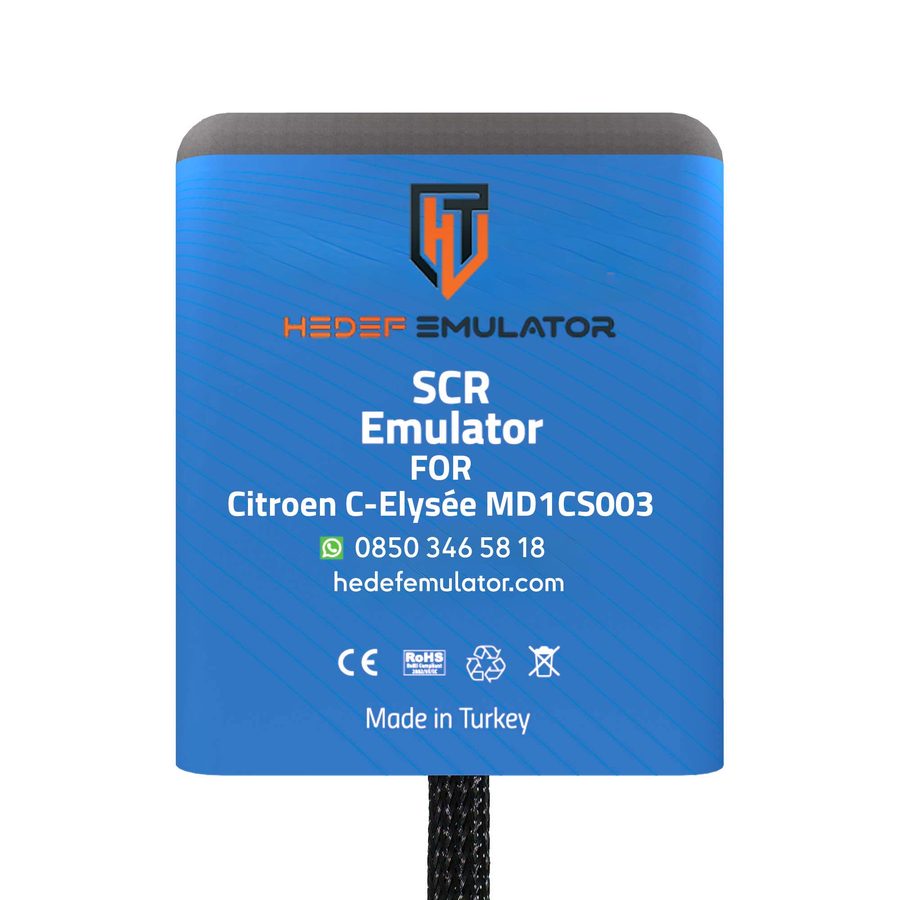 RECOMMENDED DEVICECitroën C-Elysée MD1CS003 AdBlue SCR Removal EmulatorView product →
If you’re unsure which emulator is right for your vehicle, this is what we’ve been doing for more than twelve years. Over 428 products for 94 brands, backed by a 2-year warranty, free shipping and a 14-day return window. Message your model and ECU to our 24/7 WhatsApp line (0507 687 18 40) and we’ll pin down together which unit fits your car; MD1CS003, SID212 or DENSOD5E1C, it makes no difference, we’ll find the right match.
Legal notice: Modifying or disabling emissions hardware is subject to legal restrictions on road use and vehicle inspection in many countries. Our products are supplied for off-road use, export, racing and testing purposes; legal responsibility rests with the user.
Frequently Asked Questions
Can I reset an AdBlue warning by cycling the ignition on and off?
If it is a simple level or fluid warning and you have already topped up the tank, a few ignition cycles can clear it. But if there is a stored fault code in the background (for example P204F or P20E8), cycling the ignition changes nothing; the system just brings the warning straight back.
I filled the AdBlue tank but the warning is still on, why?
Two possibilities. Either the system re-reads the level after a few ignition cycles or a short drive (give it a little time), or the warning is not about level at all but about a sensor, pump or injector fault. In the second case topping up solves nothing, because there was already enough fluid in the tank.
What happens when the AdBlue remaining-starts counter reaches zero?
On French (PSA) systems in particular, the car counts down the number of remaining engine starts. Once it hits zero the vehicle will not start again, and at that point even adding AdBlue on its own will not free it up; the system has to be reset with a diagnostic tool.
Does disconnecting the battery clear an AdBlue fault?
No. Disconnecting the battery may wipe volatile memory, but it will not erase a fault code written permanently to the ECU, nor physical faults like crystallisation, a bad sensor or a failing pump. The warning almost always comes back, and you risk resetting other learned settings in the process.
If the AdBlue warning keeps coming back, what is the permanent fix?
If the warning keeps returning there is a physical fault underneath, and a reset will not close it. The lasting options are to replace the failed part, or to disable the SCR system from the outset with a plug-and-play emulator that fits the original socket and stops the fault from ever being logged.
Recommended Products
Looking for the right emulator for your vehicle?
Send us your make and chassis details and our experts will find the right solution in seconds.