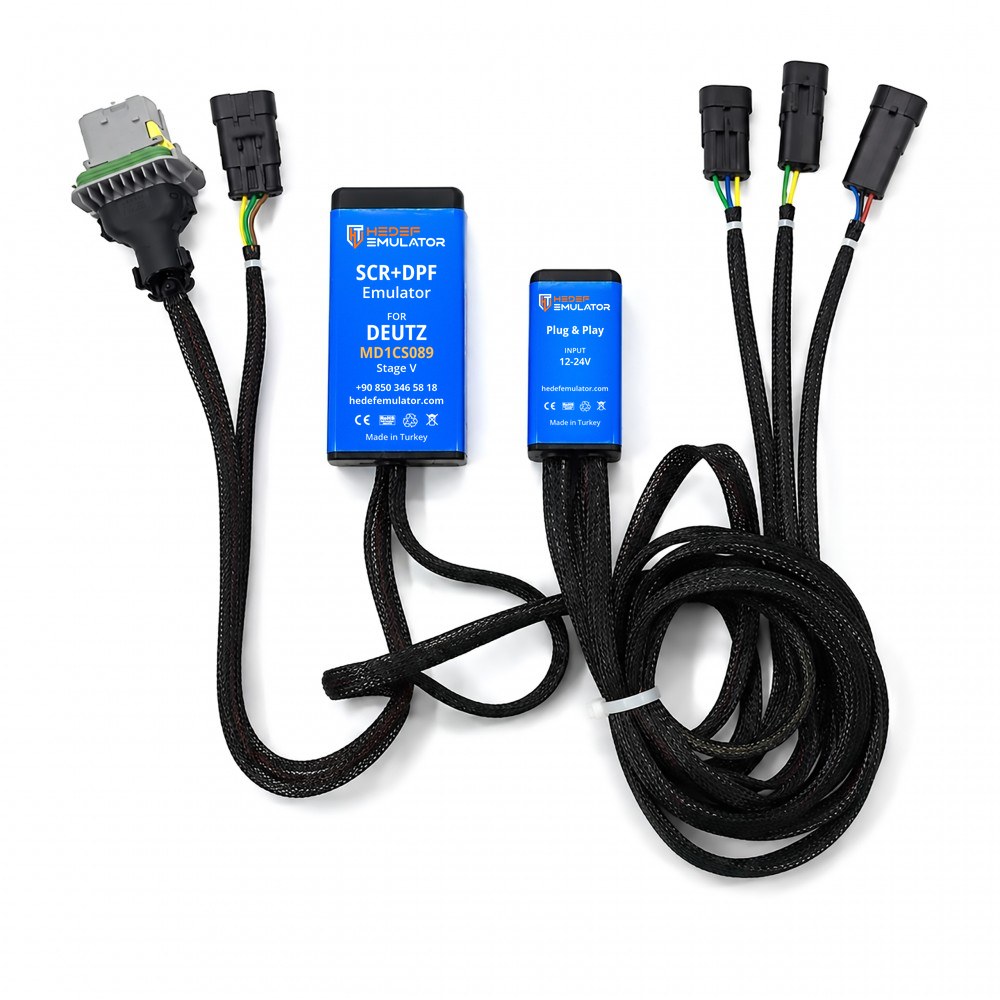
Deutz Stage 5 MD1CS089 AdBlue SCR + DPF Removal Emulator
Simulates both NOx sensors, the AdBlue tank unit, dosing injector, tank heater and DPF differential pressure sensor on Deutz Stage V (KF) engines with the Bosch MD1CS089 ECU, so the warning lamps and the power derate stay off.
When the AdBlue lamp comes on in a Deutz-powered machine, that is usually the end of the working day. On the Stage V generation the Bosch MD1CS089 engine ECU listens to every part of the exhaust line on its own: the two NOx sensors before and after the SCR catalyst, the level-quality-temperature unit in the AdBlue (DEF) tank, the dosing injector, the tank heater and the DPF differential pressure sensor. If any one of them stops sending the value the ECU expects, a warning appears on the display first, and if nothing is done the engine is derated. A loader lifting at half power or an excavator with a sluggish arm is not much more use on site than a machine that will not start. The Hedef Emulator Deutz Stage 5 MD1CS089 AdBlue (SCR) + DPF emulator generates the data those six components are supposed to send. The ECU sees a healthy system, logs no faults and the machine keeps working at full power.
How Does It Work?
The emulator is a two-module harness supplied with machine-specific connectors: the main SCR+DPF module and an auxiliary module wired to it. During installation the relevant SCR and DPF sensor and actuator plugs are disconnected on the machine side and the emulator's connectors are plugged into those connections; there is no wire cutting or soldering in the loom. With the ignition on, the emulator sends the MD1CS089 the values it expects to see: realistic NOx readings, a full AdBlue tank with correct fluid quality, an active injector and tank heater, and a DPF that is not loaded. The ECU stops looking for dosing, heating or soot-load faults, and the operator inducement system never steps in. The emulator does not touch the ECU software, so the engine's own calibration stays exactly as it left the factory.
Why do Stage V Deutz engines suffer so many AdBlue and DPF faults?
EU Stage V introduced a particle number limit for non-road mobile machinery engines for the first time. The practical way to meet it is a diesel particulate filter, so a DPF became standard on most Stage V engines, and on the more powerful ones an SCR (AdBlue) system was added to bring NOx down. The result is a far busier exhaust line than in the Stage IV days, and many more sensors for the ECU to monitor.
The way construction and handling equipment works does these systems no favours. An excavator spends long stretches idling, a forklift shuttles back and forth over short distances, a generator runs at light load for hours. The exhaust never gets hot enough for the DPF to clean itself, so the differential pressure keeps climbing. On a dusty site, dirt that gets into the AdBlue tank wears the injector, and on cold mornings the tank heater or the level unit throws a fault. NOx sensors drift over time under vibration and constant heat cycling. A failure in just one of these parts is enough for the MD1CS089 to flag the whole SCR or DPF system as faulty.
What happens to the machine when a fault appears?
On Stage V machines an emissions fault does not stop at a warning lamp; the operator inducement system works in stages. First a warning and a fault code appear on the display. If the fault is not cleared, low-level inducement starts and available engine torque is cut noticeably. Leave it longer and severe inducement follows; in most cases the machine is held close to idle or can no longer do its job.
On site that means a hired machine cannot be returned, the schedule slips and the operator sits waiting for the service van. And a few weeks after one sensor is replaced, another link in the chain can fail. The emulator breaks that cycle at the source: the ECU never sees a fault that calls for a derate.
Is your machine compatible? Check before ordering
This emulator is built for Deutz Stage V (KF) engines running the Bosch MD1CS089 ECU. Before you order, check these four points:
- ECU label: MD1CS089 should appear on the ECU label or on the ECU identification screen of your diagnostic tool.
- Emission stage: the engine plate or the machine's type plate should say Stage V (EU V).
- Exhaust hardware: the line should have both AdBlue (SCR) and a DPF. If your Stage V engine has a DPF only, message us before ordering.
- Connectors: plugs can differ between machine manufacturers. Send a photo of the ECU label and the NOx sensor plugs to our WhatsApp line and we will confirm the right harness with you.
Installation step by step
Installation is plug-in, with no wire cutting. A technician who is comfortable with vehicle electrics will have no trouble with it:
- Prepare: switch off the ignition and disconnect the battery. Locate the plugs for the upstream and downstream NOx sensors, the level-quality-temperature unit and heater in the AdBlue tank, the AdBlue injector and the DPF differential pressure sensor.
- Disconnect: unplug the relevant connectors on the machine side. Tape the open ends against dust and water and secure them with cable ties.
- Fit the emulator: plug the harness connectors into the matching connections. Clamp the modules somewhere with little vibration, away from exhaust heat and moving parts.
- Check: reconnect the battery and start the engine. Confirm there is no emissions warning on the display, clear the stored historic codes with a diagnostic tool and run the machine under load for a short while.
Points to watch during installation
- Forgotten plug: if one of the connectors that should be removed is left in place, that component's fault will remain. If a warning persists after fitting, check this first.
- Stored codes: some warnings can stay on the display until the historic fault codes are cleared; that does not mean the emulator is not working.
- Placement: do not mount the modules near the exhaust pipe, the turbo or the DPF housing.
- Washing: do not aim a pressure washer directly at the connectors, and tie the wiring so it is not under tension.
- Physical blockage: the emulator solves the electronic side. A completely blocked filter still restricts the exhaust physically, so in that case the filter needs cleaning.
Replacing parts or fitting an emulator?
Keeping the aftertreatment chain of a Stage V Deutz engine alive with original parts rarely ends with one sensor. Keep these points in mind when you compare:
- The NOx sensors, the AdBlue injector and the tank unit are separate spare parts; replace one and the others are still the same age and working in the same conditions.
- Cleaning or renewing a DPF means stripping it out and taking the machine off the job, which adds more downtime.
- Lead times, especially for imported sensors, can leave a machine standing for days.
- The emulator is a one-off fix; once fitted, none of these six components will bring back a fault or need refilling.
Reversibility, support and warranty
Because no wires are cut, going back to standard is simple: remove the emulator, refit the original plugs and the machine is back on its factory wiring. If you get stuck at any point during installation, send a photo to our WhatsApp support line. The emulator comes with a 2-year warranty, and shipping is free within Turkey and worldwide.
Frequently Asked Questions
How do I know my machine has the MD1CS089 ECU?
The Bosch label on the ECU shows MD1CS089, and it also appears in the ECU identification when you connect a diagnostic tool. If you cannot get to the label, send a photo of the engine plate to our WhatsApp line and we will check it with you before you order.
Does one device handle both the AdBlue and the DPF faults?
Yes. The kit simulates both NOx sensors, the AdBlue tank level-quality-temperature unit, the injector, the tank heater and the DPF differential pressure sensor at the same time. You do not need separate devices for SCR and DPF.
Do I need to cut wires or solder anything?
No. The emulator is a plug-in harness: the relevant sensor plugs are disconnected and the emulator's connectors go in their place. Connectors can vary between machine manufacturers, which is why we ask for a photo of the plugs before you order.
Do I still need to fill up with AdBlue after installation?
No. With the dosing system out of the loop there is no need to top up AdBlue. We recommend draining whatever is left in the tank so it does not sit there for months.
Do I have to remove the DPF?
The emulator takes care of the electronic side: the ECU no longer asks for regenerations based on soot load and does not log faults. A completely blocked filter, however, still restricts the exhaust physically. If the filter is badly blocked it needs cleaning; follow your workshop's assessment on that.
My diagnostic tool shows faults as SPN/FMI. Is that a problem?
No. On Deutz-powered machinery, fault codes usually appear in the J1939 SPN/FMI format. The emulator deals with the cause, not the code format: because it supplies the sensor and actuator data in the correct range, the code does not come back.
Does it change engine power or the ECU software?
The emulator is not a remap or a power upgrade, and it does not touch the ECU. It only stops the derate triggered by emissions faults from kicking in, so the engine runs at its factory power.
If I remove the emulator, does the machine go back to standard?
Yes. No wires are cut, so once the emulator is unplugged and the original connectors are refitted, the machine is back on its factory wiring.
What are the warranty and shipping terms?
The emulator has a 2-year warranty. Shipping is free within Turkey and worldwide, and our WhatsApp support line can help you during installation.
Is it legal to use this emulator?
Rules on emissions systems vary by country and by use. The product is intended for off-road use, closed sites, testing and service purposes, or regions where local regulations allow it. Compliance with local rules is the user's responsibility.
Supported Models
This emulator is compatible with the following models that share the same ECU platform:
Installation Video
Step-by-step installation — plug-and-play with no cutting or soldering. About 10 minutes.