MD1CS003 ECU: Which Vehicles Get an AdBlue Delete
A silver Citroën Berlingo rolls into the workshop with an amber engine lamp glowing on the cluster and a line underneath it: “AdBlue fault, 340 km remaining.” The owner is uneasy. “Mate, when that countdown hits zero, does the car just stop?” he asks. You plug in the reader and a single code lights up in memory: P20E8. Before you have even lifted the bonnet, you already have a fair idea which control unit is running the show. You have seen this scenario dozens of times, and nearly every time the same name comes up: MD1CS003.
Here is the interesting part. The customer asks “have you got a Berlingo emulator?” but that is the wrong question. The right question is “which ECU is in this car?” Because the same Berlingo, built in a different year, can carry a different control unit. In this piece I explain what the MD1CS003 is, which vehicles you will find it in, and why an AdBlue-only solution is enough in most cases, with examples straight from the bench.
What Exactly Is the MD1CS003?
The MD1CS003 is a Bosch-generation engine control unit (ECU). In other words, it is the code name for the box that acts as the engine’s brain, managing everything from fuel injection to turbo boost, from emission control to SCR dosing. The code on its own does not mean a single make or model; the same hardware family can be used across different models from several manufacturers.
You will mostly meet the MD1CS003 within the PSA/Stellantis group. A large share of the diesel models from Peugeot, Citroën, DS and Opel carry this unit. On top of that, some Toyota models show the same ECU too, especially the commercial versions built jointly with PSA. For the technically minded reader the key point is this: once you recognise an MD1CS003, you are already a step ahead on that vehicle’s emission architecture.
In practice: Reading a car by its ECU rather than its badge is the shortest route to the right fix first time. Even within the same model, the ECU can change as the engine type changes; so confirm the control unit before you make a call.
Why “AdBlue-only”? The SCR and DPF Split
On the vast majority of vehicles carrying an MD1CS003, the emission system is run down two separate lines. On one side is the soot management tied to the particulate filter (DPF); on the other is the SCR system that scrubs nitrogen oxides with AdBlue injection. On these cars the SCR architecture is mostly AdBlue-only, that is SCR-only; the DPF side works independently and is usually trouble-free.
The practical upshot for you is clear: if the problem sits only on the AdBlue/SCR side, an AdBlue-only emulator that covers just that side is enough on most cars. You do not need to overhaul the whole system. If you want a deeper look at this split between SCR and DPF, and why AdBlue is a headache all of its own, take a look at what AdBlue/SCR is and why it gets removed.
Caution: Not every MD1CS003 is the same. On some COMBO units this ECU manages SCR and DPF together. In that case a solution covering only the AdBlue side falls short. To pick the right device, confirming the VIN and the model year is essential. Verifying the brain before you say “definitely fits” is the key to not creating extra work later.
Which Vehicles Have the MD1CS003? ECU → Make → Model Table
The most requested unit in the catalogue is the MD1CS003. There is a single reason for it: it is spread across the PSA/Stellantis group’s wide model range. The table below gathers, in one place, the vehicles you will meet this ECU on most often at the bench.
| ECU | Make | Example Models | System |
|---|---|---|---|
| MD1CS003 | Citroën | Berlingo, C3, C3 Aircross, C4, C4 Cactus, C-Elysée, SpaceTourer | SCR (AdBlue-only) |
| MD1CS003 | Peugeot | 508, Partner, 2008, 3008 | SCR (AdBlue-only) |
| MD1CS003 | Opel | Grandland X | SCR (AdBlue-only) |
| MD1CS003 | DS | 7 Crossback | SCR (AdBlue-only) |
| MD1CS003 | Toyota | Proace City | SCR (AdBlue-only) |
| MD1CS003 | (COMBO variant) | Varies by model year | SCR + DPF (confirmation needed) |
Looking at this table, it becomes clearer why the MD1CS003 is the “most common” unit. From light commercials like the Berlingo and Partner to SUVs like the 3008 and Grandland X, from saloons like the C-Elysée to the minibus class like the SpaceTourer, a wide range shares the same brain. For fleet owners that is an advantage too; across a mixed park of different models you can work to a single, common logic.
The Most Common Fault on the MD1CS003: P20E8
The code you will run into most while working with this unit is P20E8. On PSA vehicles the bulk of AdBlue-related faults cluster around this pressure/pump axis. A problem in the AdBlue dosing pump, the pressure sensor or the injector usually shows itself as P20E8 first. Alongside it you will often see related codes: P203F flags the reductant (AdBlue) level being read as very low, while P204F points to a general performance fault in the reductant supply/dosing system. The table below sums up the picture you will commonly see on MD1CS003 vehicles.
| Symptom | Likely Source | Typical DTC |
|---|---|---|
| AdBlue warning on the dash + countdown | SCR dosing/pressure | P20E8 |
| Rough idle, a sense of power loss | Low AdBlue pressure | P20E8 |
| Start restriction (once the countdown hits zero) | SCR shutdown | P20E8 / P203F / P204F |
| Warnings more frequent in the cold | Crystallisation/freezing effect | Variable |
If you want a tidy reference for reading codes, the diesel emission fault codes guide explains what each of these means one by one. There is no need to panic when you see P20E8; it is a signpost telling you exactly where the system got stuck.
In practice: Stepping in before the countdown reaches zero is always more comfortable. But even if it has already zeroed out, the situation is not a dead end; with the right hardware the system returns to normal behaviour. Instead of a panic purchase, confirming the ECU first saves you both time and money.
The Right Answer to “Is There an Emulator for Renault?”
We hear this question almost every day, and it has no one-word answer. Because “Renault” is a make, whereas what determines the emulator choice is the ECU. A different model of the same make, even a different engine version of the same model, can carry an entirely different control unit. So saying “it fits/does not fit this make” is a technically incomplete approach.
The right method is this: first identify the vehicle’s ECU code. If an MD1CS003 comes up, you look to this family’s solution. If a different code comes up (for example SID212, SID321, MRD1, MD1CS016, MD1CS069, EAS4 or DENSOD5E1C), you turn to the device specific to that code. Thinking in terms of the ECU rather than the make protects you from the wrong product. If you also want to clear up the difference between an emulator and software/remap, take a look at the emulator vs software/remap comparison.
What an Emulator Is, and What It Is Not
Let us clear up a point that often gets confused here. An emulator is plug-and-play hardware that fits into the vehicle’s original socket. It is not software, it is not a remap. It does not touch the software inside the ECU, it does not change any file, and it needs no cutting or soldering. Physically, it supplies the signals the SCR system expects and makes the system “see” itself working normally.
Fitting takes about 10 minutes on average. When you sell the car on, or in any situation where you need to return it to standard, you can remove the device and take the vehicle back to how it left the factory. That reversibility is the single most important trait that sets an emulator apart from software-based work. It leaves no permanent trace; you take it out just as you put it in.
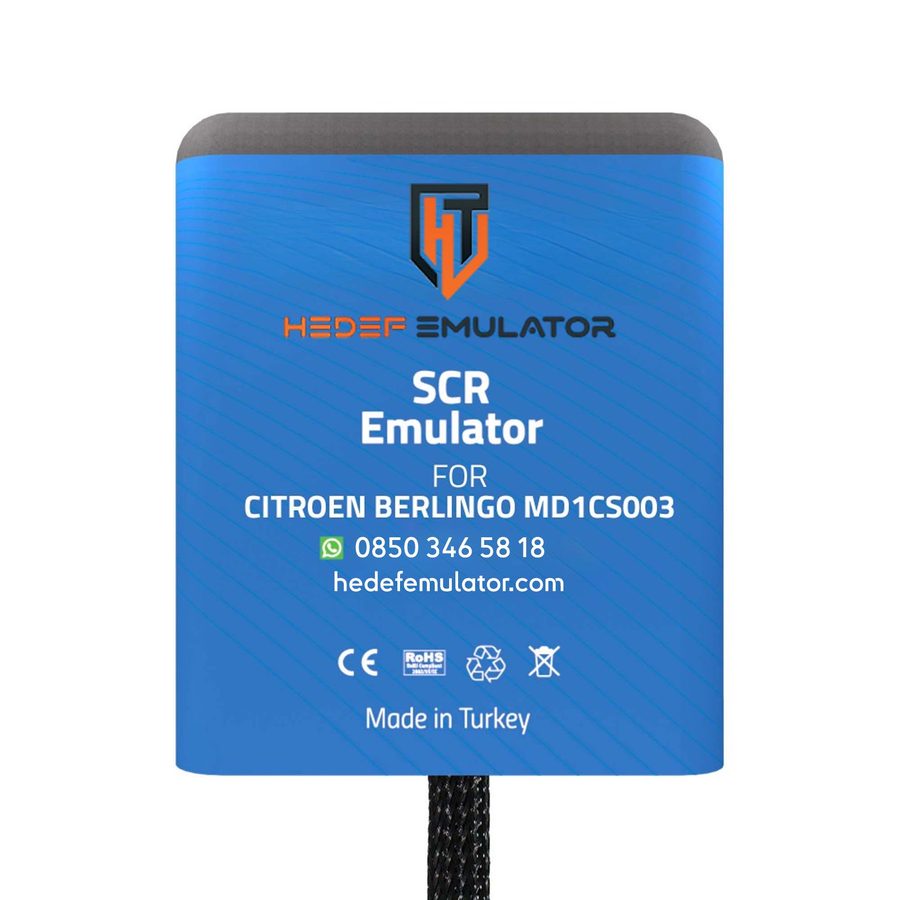 RECOMMENDED DEVICECitroën Berlingo MD1CS003 AdBlue SCR Removal EmulatorView product →
Over 12 years of experience is behind us when it comes to choosing the right device for the MD1CS003. The catalogue covers more than 428 products across 94 makes; so whatever ECU your vehicle carries, there is a strong chance the match already exists. Every product comes with a 2-year warranty and free shipping. Wherever you are unsure, you can get an ECU check from our 24/7 WhatsApp support line (0507 687 18 40), and with the vehicle details you send we can pin down the right device together. If it does not sit right with you, your 14-day return right is reserved as well.
A Short Road Map to Picking the Right Device
Before we wrap up, let us lay out the steps with bench logic. First read the fault code; if you see P20E8, you are most likely on the SCR/AdBlue side. Then confirm the ECU code; if an MD1CS003 comes up, you are in the right family. After that, use the model year and VIN to confirm whether the unit is AdBlue-only or a COMBO (SCR+DPF) variant. Skip those three steps and the job almost sorts itself out.
The fact that the MD1CS003 is so widespread is actually in your favour. Because it is a unit you meet so often, its solution is well established too. From the Berlingo to the 3008, from the Grandland X to the Proace City, you can work to the same logic; confirming the ECU code first is all it takes.
Legal notice: Modifying or removing emission hardware is subject to legal restrictions in many countries regarding road use and inspection. Our products are supplied for off-road use, export, racing and testing purposes; legal responsibility rests with the user.
Frequently Asked Questions
Which vehicles use the MD1CS003?
Mostly the PSA/Stellantis group: Citroën Berlingo, C3, C3 Aircross, C4, C4 Cactus, C-Elysée, SpaceTourer; Peugeot 508, Partner, 2008, 3008; Opel Grandland X; DS 7 Crossback and the Toyota Proace City. Because the same make can carry a different ECU on a different model, the correct device is confirmed against the VIN and model year.
Is an AdBlue-only emulator enough on the MD1CS003?
On most vehicles with this ECU the SCR system is an AdBlue-only architecture; the DPF is managed separately. So a device that covers only the SCR side is enough on the majority of cars. On some COMBO units, though, the MD1CS003 manages SCR and DPF together, which is why a model-year check is essential.
What does the P20E8 fault code mean?
P20E8 points to an AdBlue pressure/dosing fault in the SCR system. On PSA vehicles the bulk of AdBlue-related faults show up along this pressure-pump axis. It usually traces back to the pump, the dosing injector or the pressure sensor.
Will an MD1CS003 emulator fit Renault vehicles?
The straight answer depends on the ECU, not the badge. Renault models mostly use a different generation of control unit. You have to confirm the vehicle's ECU code first; if an MD1CS003 is found, the right emulator is chosen, otherwise a different device is needed.
Does an emulator harm the vehicle's ECU software?
No. An emulator is plug-and-play hardware that fits into the original socket; it never touches the ECU software and needs no cutting or soldering. It fits in about 10 minutes and can be removed to return the vehicle to standard whenever needed.
Recommended Products
Looking for the right emulator for your vehicle?
Send us your make and chassis details and our experts will find the right solution in seconds.