
Is an AdBlue Emulator Safe or Will It Damage Your Car?

The mechanic said it as he closed the bonnet: “SCR fault. Injector, pump, NOx sensor… it all adds up to serious money.” The car still runs, still covers the miles, but there’s an amber warning on the dash and a countdown ticking away in the background. After a set number of miles it will cut engine power, then it won’t start at all. That’s the point where someone tells you: “Just fit an emulator and it’s sorted.” And you rightly pause: Is this thing safe, will it damage my car?
It’s good that you’re asking. Because online there are two extremes on emulators: the seller who calls it a cure-all, and the fear-mongers who say it will wreck your car. The truth, as usual, sits in the middle and it’s technical. No fluff here; I’ll explain in plain mechanic’s terms what an emulator does to your car and ECU, what it does not do, how it affects the warranty, and where things genuinely go wrong.
What exactly is an emulator, and what does it do?
Let’s clear up the most common misunderstanding first. An AdBlue emulator is not software. Nobody goes into the ECU’s brain and writes code. An emulator is a small piece of hardware that plugs into the vehicle’s original AdBlue/SCR control socket — it works on plug-and-play logic.
What does it do? The SCR system normally reads data from a stack of sensors: NOx levels, AdBlue level, temperature, quality. When one or more of those sensors fails (say a P204F reductant system performance code or a P229F NOx sensor heater circuit code drops), the ECU panics, lights the warning lamp, and cuts torque. The emulator steps in and sends the ECU the signal that “everything is fine, the system is running healthy.” In other words, it reproduces valid values on the sensor lines.
In practice: The emulator doesn’t fool the ECU, it talks to it. It uses the socket already in the vehicle’s own wiring loom and solders nothing to anything external. That’s why installation is quick; there’s no cutting, no soldering, no stripping out the dash.
This distinction matters because the answer to “will it cause damage” is largely hidden right here. A piece of hardware that never touches the software and simply plugs in leaves no trace when it’s removed.
Emulator vs Remap/Delete vs OEM Repair
This is where people get most confused. “Emulator” and “software delete” (remap/delete) are assumed to be the same thing, but technically they are two very different routes. Then there’s the classic OEM repair. Let’s line all three up side by side.
| Criterion | Emulator (Hardware) | Remap / Delete (Software) | OEM Repair |
|---|---|---|---|
| Touching the ECU | Doesn’t; plugs into socket | Permanently alters the ECU file | Doesn’t |
| Reversibility | Removing it restores factory state | Hard; needs the old file, traces may remain | Already original |
| DTC (fault) generation | None with the right device | Permanent DTCs if done wrong | Zero once the fault is fixed |
| Installation time | A few minutes | 30-90 min, file work | Can take days |
| Restoring the system | Unplug, refit original socket | Requires reloading the original file | Not needed |
| Typical risk | Wrong ECU match | Bad write, hard to reverse | High cost, recurring fault |
In short, the verdict is clear: the emulator’s greatest strength is reversibility. With a remap that rewrites the ECU file, if the job goes wrong or you lose the original file you’re stuck wrestling with the brain’s software. With an emulator, the worst case is you unplug it, refit the original socket, and the car goes back to factory condition.
If you want to dig deeper into the difference between the two, we covered emulator vs software/remap in a separate article.
So does it really damage the ECU?
The honest answer: not when the right device is fitted to the right vehicle. But the word “right” in that sentence is everything.
An emulator writes nothing into the ECU. It doesn’t touch the flash memory, doesn’t corrupt the original calibration. It only mimics the electrical signals on the sensor lines. Viewed this way, the chance of permanently damaging the ECU is physically nil — because it never enters a modifiable software layer at all.
So where do the damage stories come from? From two sources:
- Wrong ECU match. Within the same model family, different years can carry different brains like MD1CS003, SID321 or EAS4. Fit a device built for one brain onto a different one and the system sees the wrong protocol, the warning light comes on, torque is cut. The device is blamed for “causing damage,” when in fact the wrong device was fitted.
- Poor-quality device. Cheap, generic emulators can’t reproduce the signal correctly in cold weather, during regeneration, or across certain drive cycles. These lead to fault codes and stress.
Caution: An emulator’s risk of damaging the car is directly proportional to the device’s quality and correct matching. That’s why we confirm the device by VIN/chassis number before shipping. “This brand, this model” isn’t enough; verifying the ECU type from the chassis number prevents most problems before the box is even opened.
If you’re curious why the SCR system is so sensitive and why it gets deleted, the article on what AdBlue/SCR is and why it’s deleted explains the basics.
Which cars and which ECUs does it work on?
An emulator isn’t a universal box; every vehicle family has its own brain and protocol. Correct matching starts here. A few of the brain-model combinations we deal with most often:
| ECU / Brain Type | Common Vehicles |
|---|---|
| MD1CS016 / SID321 | Renault, Nissan, Dacia diesel range |
| MD1CS003 | Peugeot, Citroën, DS, Opel and some Toyota diesels |
| SID212 | Ford commercial diesel range |
| MRD1 | Mercedes Sprinter and various passenger diesels |
| MD1CS069 | Iveco, Fiat Ducato range |
| EAS4 | Heavy vehicle and truck SCR range |
Models like the Master, Berlingo, Ducato and Actros each need a different device according to their own brain family. That’s why the right answer to “I’ve got a Ducato, will it work?” can only be given with the chassis number. You can find more detail on which vehicles use the MD1CS003 in particular in this article.
If you’re trying to solve fault codes caused by regeneration, crystallisation or sensors, the diesel emission fault code guide shows which code points to what.
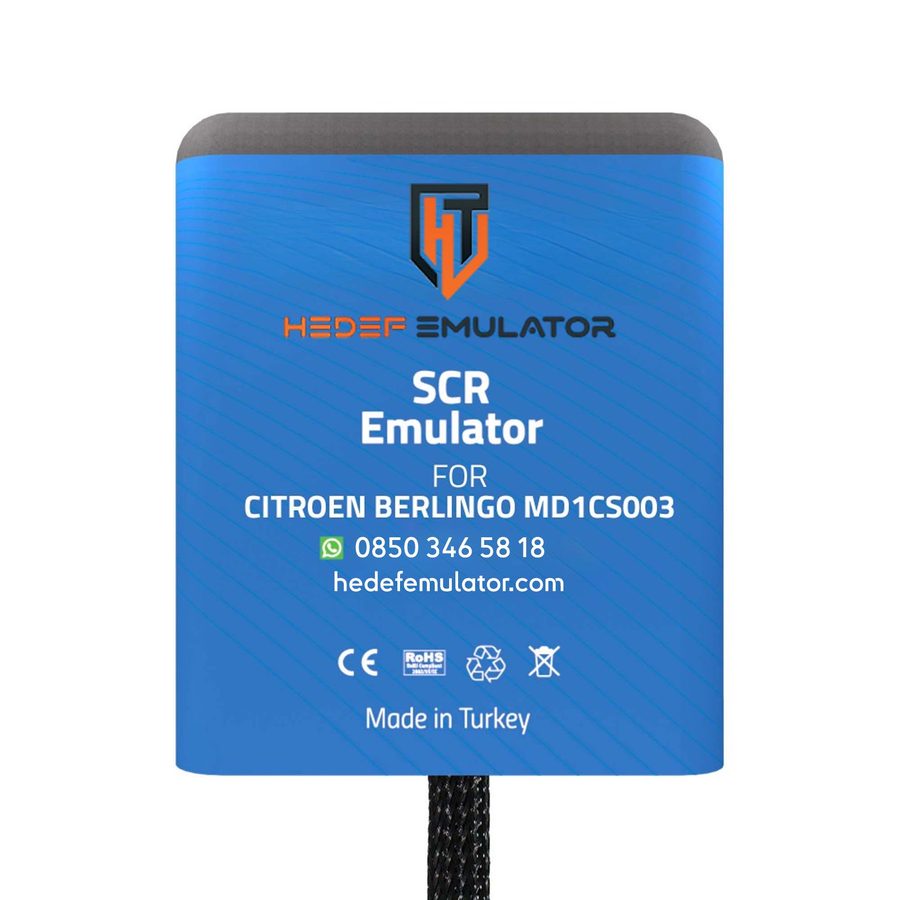 RECOMMENDED DEVICECitroën Berlingo MD1CS003 AdBlue SCR Removal EmulatorView product →
How does it affect the warranty and reversibility?
There are two separate “warranties” here, so let’s not mix them up.
The first is the vehicle’s manufacturer warranty. If the car is still under manufacturer warranty, any intervention on the emission hardware — emulator included — can have questionable warranty consequences. But the emulator holds a card here: it’s removable. Before going in for service or an inspection, you can pull the device out and refit the original socket, and the car returns to factory condition. With a remap, that’s not nearly so easy.
The second is the product’s own warranty. We give a 2-year warranty on the emulator you buy from us. If a fault arises from the device, we replace it. You also have the right to return it within 14 days; fit it, don’t like it, send it back.
Reversibility is the most concrete reason to choose an emulator. If you’re going to sell the car, put it through an inspection, or change your mind, you remove the device and go back to original. No permanent trace is left in the ECU to say “something was tampered with here.”
Installation and support
One of the most common worries is the “I can’t fit it, I’ll break something” fear. The emulator is designed for exactly this: a connector that plugs into the original socket, no cutting or soldering. Even so, we don’t leave you on your own.
With every device we send a step-by-step installation video — which socket, which colour wire, where it seats, all shown visually. If you get stuck, we have a 24/7 WhatsApp support line (0507 687 18 40); most installs are done in 10-15 minutes with guidance over the screen.
Behind us is over 12 years of experience, and our catalogue holds more than 428 products covering 94 brands. So your car is most likely a case we’ve solved dozens of times before. Shipping is free.
The legal side: let’s be straight
We can’t skip this. Deleting or modifying emission hardware is subject to legal regulation in many countries when it comes to road use and inspection. Our products are positioned for off-road use, export, racing and testing. In other words, for scenarios like closed sites, field vehicles, fleets destined for export, and test rigs.
Caution: If you use your car on the road, subject to inspection, make that decision knowingly. The emulator being removable gives you some flexibility here, but the legal responsibility rests with the user in every case. Make the call within that framework, with your eyes open.
In short, the emulator is a piece of hardware that doesn’t touch the ECU, disappears without a trace when removed, and doesn’t damage the car when correctly matched. All the risk comes down to the “right device, right vehicle” equation. And we solve that equation for you with VIN confirmation — the rest is a job of a few minutes.
If you have a question in mind, send us your chassis number over WhatsApp; let’s pin down together which ECU you have and the correct device.
Legal notice: Modifying or deleting emission hardware is subject to legal restrictions in many countries regarding road use and inspection. Our products are offered for off-road use, export, racing and testing purposes; legal responsibility rests with the user.
Frequently Asked Questions
Will an AdBlue emulator damage my car?
Not when the right device is fitted to the right vehicle. An emulator is a plug-and-play piece of hardware that connects to the original SCR control socket; it never touches the ECU software and needs no cutting or soldering. Almost all damage risk comes from the wrong ECU match or a poor-quality device, which is why confirming the exact model by VIN/chassis number is critical.
Will the emulator damage the ECU or corrupt its software?
No. An emulator never writes to the ECU file and never alters the existing software. It simply mimics the signals on the SCR sensor lines. Unlike a remap or delete, the ECU's original software stays exactly as it was.
If I remove the emulator later, does the car go back to standard?
Yes. Unplug the emulator, refit the original socket, and the vehicle returns to factory condition. No permanent trace is left in the ECU. This reversibility is the emulator's biggest advantage over a remap.
Does an emulator affect the warranty?
Like any change to the emission system, it pays to know the score: if the vehicle is still under manufacturer warranty, tampering with emission hardware can have warranty consequences. The emulator's edge is that it's removable; you can refit the original socket before an inspection. As for the device itself, we back it with a 2-year warranty.
Is there a real difference between a cheap emulator and an expensive one?
Yes, and that difference is the source of most problems. Cheap devices often mimic the wrong protocol, throw faults in the cold or during regeneration, and trigger the warning light. The right device is one matched to your vehicle's exact ECU code (for example MD1CS003 or SID321).
Recommended Products
Looking for the right emulator for your vehicle?
Send us your make and chassis details and our experts will find the right solution in seconds.