AdBlue Quality/Level Sensor vs NOx Sensor: Two Faults Confused

One morning at the workshop a Transit gets its verdict: “AdBlue quality fault, sensor needs replacing.” That afternoon a Sprinter rolls in with a completely different picture; the engine warning light is on, the van is stuck at 40, and the driver says “I put my foot down and it won’t pull.” Two different vehicles, and from two different mechanics the same two words keep coming up: “AdBlue sensor.” Yet the faults on these two vehicles were worlds apart.
The trouble is that in most places these two faults get lumped under one name. The wrong part gets ordered, the wrong device gets fitted, and when the light doesn’t go out it turns into “that didn’t work, let’s try this next” while money quietly burns. But the distinction is actually very clear. On one side is a sensor that measures the fluid inside the tank; on the other, one that measures the gas in the exhaust. Learn to tell them apart and you’ll land both the right diagnosis and the right fix.
Two Separate Sensors, Two Separate Jobs
Let’s clear this up from the start: the AdBlue system doesn’t run on a single sensor. There are two different eyes at either end of the chain, and they don’t do each other’s job.
The AdBlue quality/level sensor sits inside or on top of the urea tank. It does two jobs at once: it measures the amount of fluid in the tank (level) and its quality (concentration — the ratio of urea to water, read via the refractive index). So it answers both “how much is in there” and “is what’s in there really AdBlue.” Standard AdBlue is roughly a 32.5% urea solution; the sensor catches any drift from that ratio.
The NOx sensor, on the other hand, lives somewhere completely different — in the exhaust line. There are usually two of them, one before the catalyst (upstream) and one after (downstream). Its job is single: to measure the amount of nitrogen oxide (NOx) leaving the exhaust. It has no contact with the tank, the fluid or the quality; its world is hot exhaust gas. If you want to dig deeper into how the NOx sensor works and why it fails, take a look at what a NOx sensor is and how to spot a failure.
In practice: A simple memory hook: the quality/level sensor listens to the fluid, the NOx sensor listens to the gas. One looks inside the tank, the other looks out of the exhaust. Hold that one sentence in your head and you’re already halfway there.
How Do the Symptoms Split?
This is where diagnosis gets practical. When these two sensors fail, the vehicle gives you diametrically opposite reactions.
When the level/quality sensor fails, the typical scenario goes like this: the dash shows “AdBlue quality low”, “wrong fluid” or — the most infuriating one — “refill tank”. But you filled that tank to the brim only yesterday. The fluid is sitting right there; the sensor is misreading it. Usually a countdown starts (“engine won’t start in X km”) but the vehicle doesn’t drop into limp mode straight away; power is normal at first.
With a NOx sensor fault the picture is harsher. The engine warning light (MIL) comes on, then power loss sets in, torque is cut and the vehicle often drops into limp mode (the 20–60 km/h band). Here there may be no warning about the tank or the fluid at all; the problem sits entirely on the exhaust-side measurement.
Caution: It’s perfectly possible for both pictures to appear on the same vehicle at once. Stale, water-diluted fluid, for example, will both mislead the quality sensor and, over time, drop SCR efficiency and throw a secondary code on the NOx side. That’s why, before you say “this symptom means it’s definitely that sensor,” you have to read the code.
Side-by-Side Comparison
The best way to tidy up the confusion is to see it in a single table. Here’s the line-by-line split between the two faults:
| Criterion | AdBlue Quality/Level Sensor | NOx Sensor |
|---|---|---|
| Location | Inside/on top of the urea (AdBlue) tank | In the exhaust line; before the catalyst (upstream) and after (downstream) |
| What it measures | The amount and quality of the fluid (concentration / refractive index) | The nitrogen oxide (NOx) level in the exhaust |
| Typical symptom | ”Tank full but no AdBlue”, “quality low”, “wrong fluid” warning | Engine warning light (MIL) + power loss + limp mode |
| Example DTC | P203F (level range/performance), P207F (quality/performance) | P2201 (intake range/performance), P229F (heater circuit — usually the downstream sensor) |
| Which emulator | AdBlue level/quality emulator | NOx sensor emulator |
The most critical column in that table is DTC. Symptoms can be tangled up with interpretation, but the code doesn’t lie. If you’re seeing P203F or P207F the arrow points to the tank; if you’re seeing P2201 or P229F it points to the exhaust. Ultimately this code is what dictates your emulator choice too.
The Fault Codes Show You the Way
Before you even open the bonnet, the code pulled off the OBD socket is your diagnostic compass. Grouped roughly:
| Fault Code | Meaning | Side It Points To |
|---|---|---|
| P203F | AdBlue level sensor range/performance | Tank — level/quality sensor |
| P207F | AdBlue quality / performance fault | Tank — level/quality sensor |
| P2201 | NOx sensor intake range/performance | Exhaust — NOx sensor |
| P229F | NOx sensor heater circuit (usually the downstream sensor) | Exhaust — NOx sensor |
Keep this in mind: the code tells you which area the fault is in, but on its own it doesn’t say “the part is definitely dead.” P207F, for instance, sometimes comes not from a faulty sensor but from poor-quality fluid put in the tank. If you fit a new sensor and the code comes straight back, the problem is most likely somewhere else. The same logic applies on the NOx side; P229F can also come from a broken wiring harness. Whichever of these codes you’re dealing with, the essence of the job is isolating the right area. For a wider list of codes, the diesel emission fault code guide is a good starting point.
How Poor AdBlue Triggers a False Alarm
This is the issue that causes the most misdiagnoses in the field. The quality sensor reads the fluid’s refractive index and calculates urea concentration from it. Put off-spec, water-diluted or long-since-degraded fluid in the tank and the sensor will report it, quite correctly, as “quality low.”
So the sensor is actually doing its job; the fluid is what’s faulty. But the workshop reads this as a “sensor fault” and swaps the part, the same bad fluid touches the new sensor, and the warning comes right back. That’s how the loop forms. So with quality codes, the first thing to do is question the fluid in the tank before blaming the sensor. If you want to refresh what AdBlue is and its role in the SCR system, what AdBlue/SCR is and why it’s disabled lays the groundwork well.
In practice: Topping the tank up with tap water or a random jerrycan starts as a “that’ll do” and ends as a sensor fault. Use ISO 22241-compliant, sealed AdBlue; you’ll protect both the sensor and the SCR catalyst.
Picking the Right Device: Where Does the Emulator Come In?
Once you’ve pinned down which side the fault is on, the fix becomes clear too. Here it’s important to understand what an emulator actually is: an emulator is a plug-and-play piece of hardware that fits into the original socket. It’s not a remap or software. It doesn’t touch the ECU software, needs no cutting or soldering, fits in about 10 minutes, and can be removed to return the vehicle to original when needed.
The logic is simple: a fault on the level/quality side calls for an AdBlue level/quality emulator, while a NOx fault on the exhaust side calls for a NOx sensor emulator. Mix them up and fit the wrong device and the light won’t go out, because the ECU is still looking for the signal it thinks is missing. This is exactly why reading the DTC first, then confirming with VIN and model, is a step you can’t skip. On MD1CS003, MD1CS016, SID212, SID321, MD1CS069 or EDC17-based ECUs, socket types and pin layouts change from model to model; the right device only fits once it’s matched to the vehicle’s identity.
The same discipline applies to light commercials like the Transit, Sprinter, Master, Berlingo and Ducato, and to heavy vehicles like the Actros. Where you’re on the fence about the NOx side, the NOx sensor: replace or emulate comparison is a good guide.
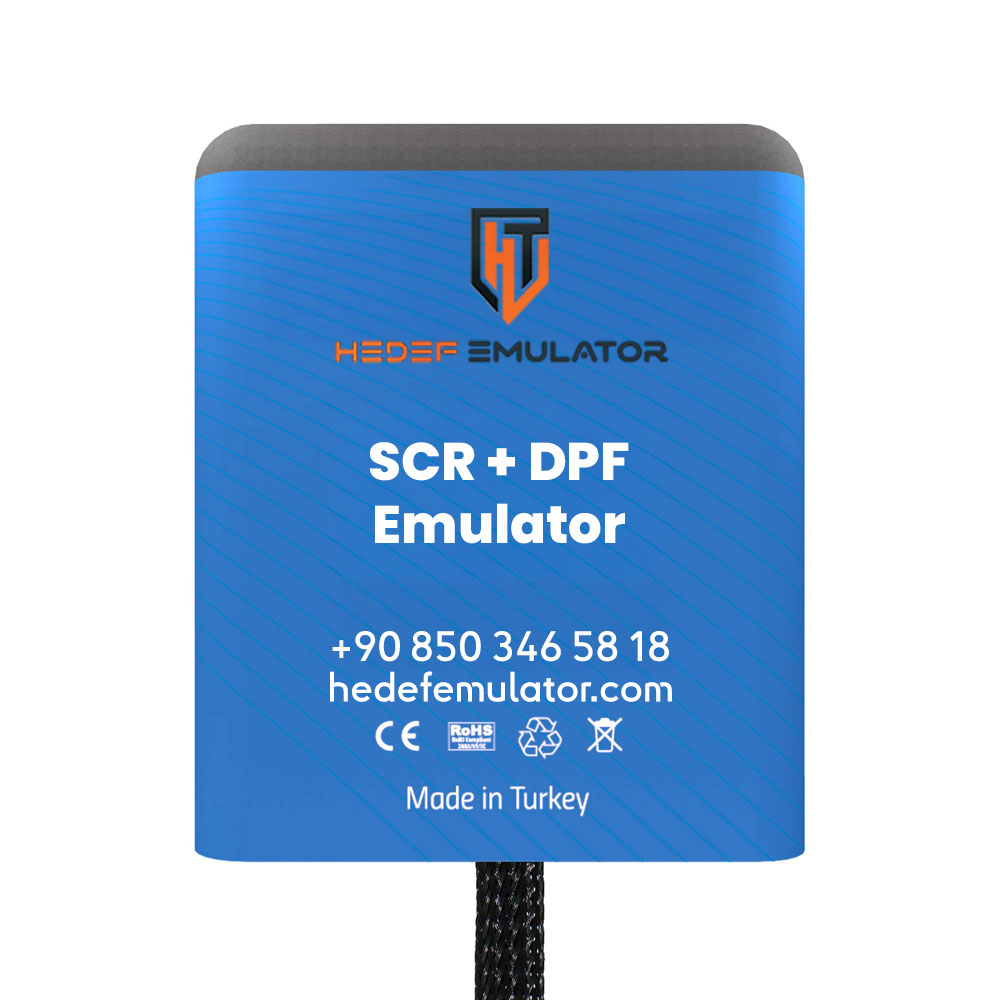 RECOMMENDED DEVICEVolkswagen Crafter MD1CS104 AdBlue Level/Quality Sensor EmulatorView product →
Whichever side you’re on, matching the right device to the vehicle’s identity is the safest route. With 12+ years of experience, 428+ products for 94 brands, a 2-year warranty and free shipping; send your model and VIN to our 24/7 WhatsApp line (0507 687 18 40) and we’ll work out together which sensor the fault is on and help you pick the right emulator. If it’s not for you, you keep your right to return within 14 days.
A Short Field Checklist
If you need to make a quick call at the vehicle, run through these in order:
- Is the warning about the tank/fluid (“quality low”, “no AdBlue”), or about power/lights (MIL, torque limit, limp)?
- Does it say “empty” even though you just filled the tank? The arrow points to the level/quality sensor.
- Is the vehicle stuck at 40, refusing to pull, with the MIL on? The arrow points to the NOx side.
- Is the code you pulled P203F/P207F, or P2201/P229F?
- Where and with what fluid did you do the last AdBlue top-up? On quality codes, that’s the first suspect.
Get past these five questions and you’ll have both the right diagnosis and the information you need to choose the right device. The rest is matching it to the vehicle’s identity.
Legal notice: Modifying or disabling emission hardware is subject to legal restrictions on road use and vehicle inspection in many countries. Our products are supplied for off-road use, export, racing and testing purposes; legal responsibility rests with the user.
Frequently Asked Questions
Are the AdBlue quality sensor and the NOx sensor the same thing?
No, they are two completely different parts. The quality/level sensor sits inside the urea tank and measures the amount and concentration of the AdBlue fluid. The NOx sensor lives in the exhaust and measures the nitrogen oxide leaving the engine. Their location, what they measure, their fault codes and their fixes are all separate.
Tank is full but the vehicle says 'no AdBlue' — which sensor is faulty?
In this classic scenario the arrow almost always points to the level/quality sensor. The fluid is physically in the tank, but because the sensor misreads the amount or the quality, the ECU thinks the tank is empty or contaminated. P203F or P207F codes confirm this picture.
Which sensor causes power loss and limp mode?
The engine warning light coming on, torque being cut and speed dropping is typically down to the NOx sensor. When the exhaust reading goes bad the ECU assumes it can no longer control emissions and drops the vehicle into a protection mode. P2201 and P229F are common codes on this side.
Can poor-quality AdBlue damage the sensor?
It doesn't burn it out directly, but it does mislead it. Fluid diluted with water or off-spec fluid throws off the quality sensor's refractive index reading and produces a 'low quality' warning even with a full tank. The real fault isn't the sensor, it's the fluid. That's why using AdBlue that meets the ISO 22241 standard matters.
What happens if I fit an emulator to the wrong sensor?
The problem won't clear. Fitting a NOx emulator to a level/quality fault, or a level emulator to a NOx fault, misses the target and the light stays on. That's why you must read the DTC first to pin down which side the fault is on, then pick the right device by VIN and model.
Recommended Products

Looking for the right emulator for your vehicle?
Send us your make and chassis details and our experts will find the right solution in seconds.