
Construction & Farm Machinery AdBlue SCR Faults Guide

At six in the morning the first operator on site fires up the excavator, works the bucket a couple of times and spots an amber light on the dash. He shrugs it off. By midday the machine is losing torque, the bucket won’t lift like it used to, and the engine feels like it’s driving with the handbrake on. In the afternoon the countdown starts: the screen reads “AdBlue fault, speed/torque limit in X hours.” There’s concrete to pour that day, the hired machine is billing by the day, and the nearest authorised dealer is three districts away.
You can live this exact scene with a tractor in a field, a forklift in a warehouse or a generator on site. For the non-road machines and agricultural vehicles we’re talking about, the SCR/AdBlue system leads a far tougher life than the same engine does in a truck. In this piece I’ll explain, in a mechanic’s plain terms, why faults hit these machines sooner and more often, what each symptom is really telling you, and what options you have to keep moving without shutting the machine down.
Why Non-Road Machines Are a Different World
Tractors, excavators, forklifts, generators and the like fall into the “non-road mobile machinery” (NRMM) class and are governed by their own emission tiers: Stage IIIB, Stage IV, Stage V. The logic resembles the Euro standards on passenger cars, but the engine’s working profile is the polar opposite. A truck runs for hours at steady revs on the motorway with a hot exhaust; its SCR catalyst sits comfortably at its ideal temperature.
Plant machinery is nothing like that. An excavator spends half the day at idle, low on revs, waiting for the bucket to fill. A tractor is loaded up in the field one moment and running free the next. A forklift stop-starts around a warehouse. That broken, lightly loaded duty cycle never brings the SCR catalyst up to operating temperature. For AdBlue (AUS 32) to break down properly and clean up the NOx, the catalyst has to be hot; when it can’t heat up, the system runs inefficiently and starts to destroy itself.
Dust, Heat and Vibration: The Site’s Three Silent Enemies
A building site or a field is a hostile environment for any electronic system. Airborne dust, the extreme heat under the engine cover and the vibration that comes with every move the machine makes attack the SCR components from three directions at once.
In practice: You’ll see the same engine brand in both a truck and a plant machine, but the NOx sensor’s life won’t be the same in each. A sensor that clocks hundreds of thousands of kilometres in a truck will start losing signal far sooner in a loader working a dusty quarry. Once the sensor starts “lying,” the ECU treats the system as faulty and cuts the torque.
Dust builds up around the level sensor and the dosing injector. Heat shortens the life of the electronic boards and the seal materials. Vibration works loose the cable connections, the sensor bodies and the pump mechanics. Each of these looks like a small effect on its own, but stacked on top of each other they start throwing SCR faults well before the lab-rated lifespan the system was designed for.
The Link Between Low Revs and Crystallisation
The most common and most insidious problem is crystallisation. AdBlue is a solution of urea in water. When it’s injected into the system, the catalyst’s heat is supposed to break it down into ammonia. But if the catalyst isn’t hot enough, the fluid can’t vaporise as intended and builds up as a hard, white deposit; that is crystallisation.
On a plant machine running for long spells at low revs, this becomes a vicious circle: the catalyst can’t heat up → AdBlue crystallises → the dosing line and injector clog → the system runs even less efficiently → more faults. We cover the technical detail of this in our AdBlue crystallisation and freezing problem article; in machines working through the winter cold it gets worse still, because AdBlue freezes at around -11°C.
One of the most common accelerators of crystallisation is poor-quality AdBlue. In areas with weak supply infrastructure, urea solution of uncertain quality gets sold from open drums. A sub-standard AdBlue both fouls the catalyst and misleads the quality sensor. How often your machine faults is directly tied to the quality of the fluid you pour in.
From Symptom to Cause: What Each Fault Points To
Most warnings on the dash look generic, but different causes sit behind them. The table below shows what you’ll most often run into on plant machinery and tractors. For a firm diagnosis you must have the fault code read; this table is only a pointer.
| Symptom / Warning | Likely Source | Why It’s Common on Site |
|---|---|---|
| AdBlue level read incorrectly | Level/quality sensor | Dust and vibration damage the sensor surface |
| Torque/speed limit (limp mode) | NOx sensor signal loss | Long idle + heat wear the sensor |
| Dosing injector clog fault | SCR crystallisation | Catalyst can’t heat at low revs |
| SCR low-efficiency warning | Catalyst fouling | Poor AdBlue + incomplete heating |
| Pump pressure fault | AdBlue pump / line | Vibration and freeze damage |
If you want a wider view of the logic behind these symptoms and the general emission fault codes, our diesel emission fault codes guide is a good starting point. If you’re curious about how the SCR and AdBlue system works at its core, the what is AdBlue/SCR and why it gets deleted article explains the fundamentals.
When the Machine Stops, the Job Stops: Site Economics
On a car an AdBlue fault is a nuisance, but you pull over and take it to a garage. On a plant machine it’s a different story. A stopped machine holds up not just its own repair bill but a whole chain around it.
A hired excavator bills by the day; even sitting broken, that charge keeps running under most contracts. A tractor that faults at harvest time risks the crop’s quality with just a few days’ delay. On site, jobs like concrete pours and foundation digs are planned in sequence; one machine stopping leaves the next crew waiting too. On top of that comes the difficulty of getting a technician out: the machine sits fixed on site, and more often than not the dealer has to come to it or the machine has to be shifted on a lowboy.
In practice: A fleet manager runs the numbers like an accountant. The part cost of a single NOx sensor is a costly item on its own; on most machines one NOx sensor runs into the hundreds, and when both an upstream and a downstream sensor are needed the bill doubles. Add labour and the machine sitting idle for two or three days, and a single fault becomes a serious cost. That’s why, on non-road machines, the decision to “keep the machine running” is often not purely technical but economic.
Brand Doesn’t Matter: Same Engine, Same Grief
The brands you see on site may differ, but the SCR system obeys the same laws of physics. CASE, John Deere, Deutz-engined units, Cummins-powered machines, Atlas Copco generators — crystallisation, sensor wear and the low-rev problem work the same way in all of them. The cab design and the menu language change, but the catalyst’s heat-up problem is brand-independent.
| Machine type / brand | Typical use | Most common grief |
|---|---|---|
| CASE / John Deere tractor | Variable load in the field, long idle | Crystallisation, level/quality sensor fault |
| Deutz-engined plant machine | Dusty, intermittent site work | NOx sensor signal loss, dosing injector clog |
| Cummins-powered loader | Quarry, heavy dust | Sensor wear, SCR low efficiency |
| Atlas Copco generator | Long spells at low load in a fixed spot | Catalyst can’t heat up, crystallisation |
So the claim that “brand X can’t handle AdBlue” is usually misleading. The problem lies not in the brand’s quality but in the environment the machine works in and the fluid poured into it. Two loaders of different brands working the same dusty quarry will throw similar faults in similar time.
What an Emulator Is, and How It Differs From an SCR Strip-Out
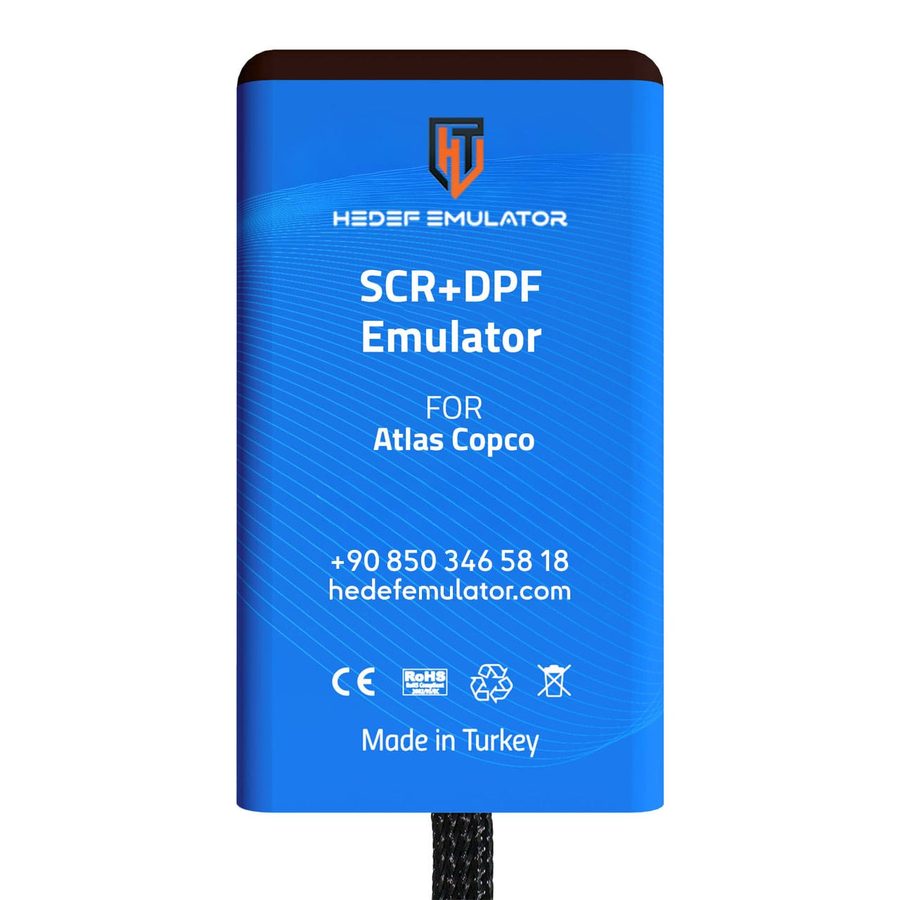
The point where people get most confused is the terminology. An emulator is not software or a remap. It’s a plug-and-play device that fits into the original SCR socket. It mimics the signals the sensors send to the machine’s engine ECU, so the system keeps running normally as if AdBlue were active and never drops into a torque limit.
The difference is this: an emulator doesn’t touch the ECU software, needs no cutting or soldering, fits in minutes, and can be unplugged to return the machine to its original system whenever needed. You don’t physically remove the catalyst or the pump; everything stays in place, only the electronic signal is managed. That keeps the change reversible and means the components are still present in any inspection.
Another common question is what to do about a sensor fault. When only the NOx sensor has failed, is a swap or an emulator the smarter move? We compared the two in NOx sensor: replace or emulate. And the question of whether an emulator harms the engine is answered in detail in is an AdBlue emulator safe.
 RECOMMENDED DEVICECase Euro 6 AdBlue SCR Removal Emulator — NOx BypassView product →
Choosing the Right Model and Fitting It
On plant machinery and tractors, the most critical step is choosing an emulator matched to the machine’s engine unit and SCR architecture. Even within the same brand, the socket and signal setup can change by engine and model year. The wrong model either won’t work at all or will throw the machine straight back into a fault. So the machine’s make, model, engine type and, where possible, its current fault codes should be shared up front; the right hardware is picked from there.
On our side there’s over 12 years of experience and an archive spanning 94 brands and more than 428 product variants — plant machinery and agricultural vehicles included. Products ship with a 2-year warranty and free delivery, and you have 14 days to return them. If you’re not sure which model fits your machine, just message your machine details on our 24/7 WhatsApp line (0507 687 18 40) and we’ll work out the right hardware together.
Legal notice: Modifying or disabling emission hardware is subject to legal restrictions in many countries regarding road use and inspection. Our products are supplied for off-road use, export, racing and testing purposes; legal responsibility rests with the user.
Frequently Asked Questions
My tractor threw an AdBlue fault in the field and dropped power. What should I do?
Don't move until you've had the fault code read. On most tractors an SCR fault shows first as an amber light, then as a torque limit (limp mode). The code tells you whether it's the level sensor, the NOx sensor or crystallisation. If it's a sensor fault, getting the part can take days; to keep the machine working through that window an off-road emulator may come into play. For a permanent decision, proper diagnosis is essential.
Why does AdBlue fail faster on plant machinery than on a car?
Because the working conditions are far harsher. Long spells at low idle, heavy dust, extreme heat and constant vibration never get the SCR catalyst hot enough. In a cold catalyst AdBlue crystallises, while the NOx and level sensors wear out quickly under dust and vibration. The same engine lasts longer in a truck than it does in an excavator.
Is deleting AdBlue on a non-road machine legal?
Off-road / non-road use is the most defensible scenario for this kind of hardware, because the machine may never touch a public road. But site emission, inspection and tender-entry rules differ from country to country and sometimes from council to council. Don't decide without checking local regulations; legal responsibility rests with the user.
Will an emulator damage the tractor's engine ECU?
An emulator is a plug-and-play device that fits into the original socket; it doesn't touch the ECU software and needs no cutting or soldering. It doesn't strain the engine, because the engine runs normally as if AdBlue were active. It can be unplugged and the original system restored whenever needed. The real risk is choosing the wrong model or a sloppy install, so pick hardware matched to the machine's engine unit.
Can I strip the whole SCR system off my excavator?
Physically removing the catalyst and pump is both unnecessary and risky; a strip-out that doesn't correctly mimic the system's output will just throw the machine back into a fault. The right approach is to leave the SCR components in place and manage the electronic signal with an off-road emulator. That way the change stays reversible and, in any inspection, the system is still physically present.
Recommended Products

Looking for the right emulator for your vehicle?
Send us your make and chassis details and our experts will find the right solution in seconds.